
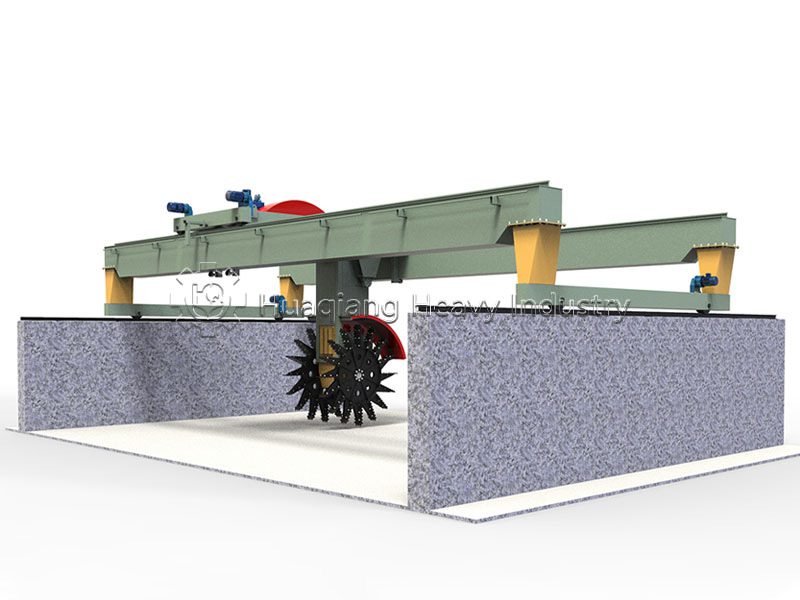
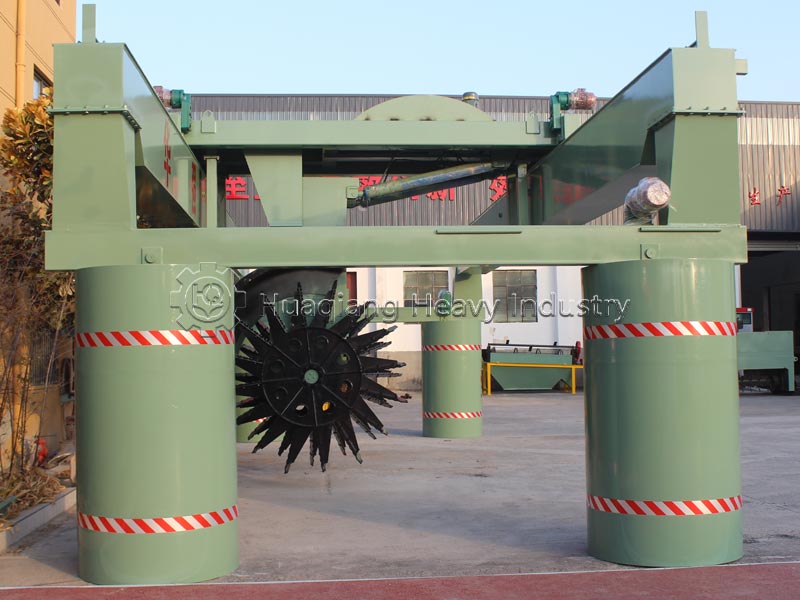
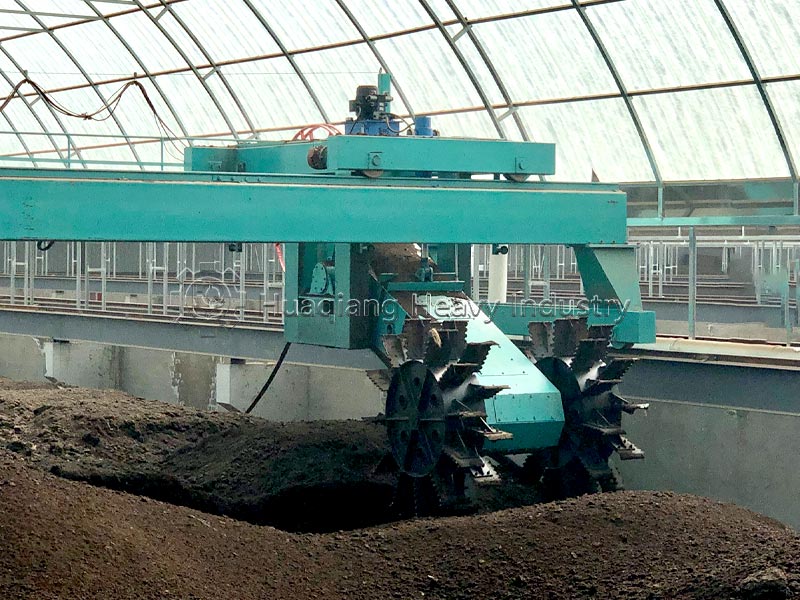
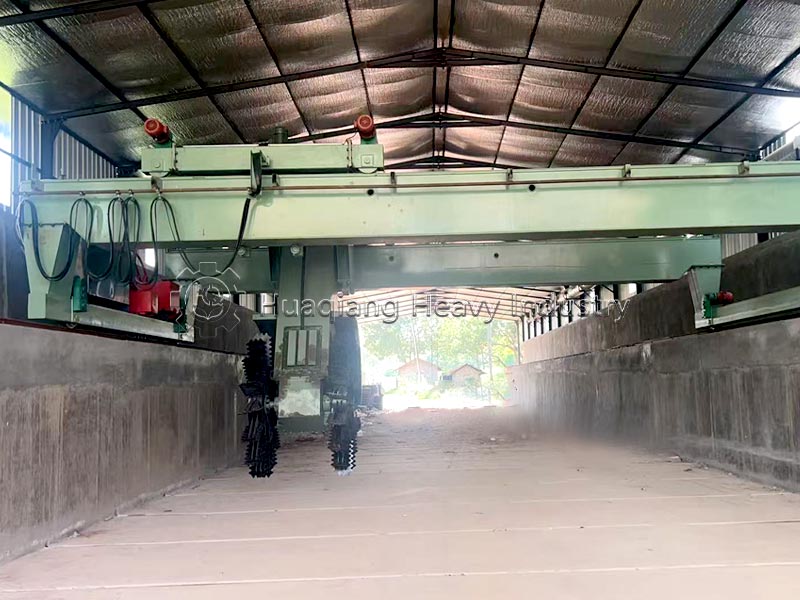
Large Wheel Compost Turning Machine
The large wheel compost turning machine is a widely used piece of equipment for windrow composting processes. It utilizes a large-diameter rotating wheel to cut directly into the windrow, scooping up, breaking apart, and throwing the material backward, thereby simultaneously performing the tasks of turning and displacement. Unlike trough-style turners that require dedicated concrete fermentation troughs and rails, the large wheel compost turning machine features its own travel mechanism; it has minimal site requirements and can operate on any level ground, allowing for flexible layout of windrow orientation and length based on actual conditions. Offering deep turning capabilities, high processing efficiency, and ease of operation and maintenance, it is a popular choice for manure treatment at small-to-medium-sized livestock farms and for township-level organic fertilizer processing projects. A single unit can service multiple windrows, with adjustable turning frequency and travel speed to meet the operational needs of different fermentation stages and material conditions.
Fermentation Process Using the Large Wheel Compost Turner
Before the process begins, livestock manure is mixed with bulking agents—such as straw powder or rice husks—according to a specific formula to adjust the moisture content to an optimal range. The mixed material is piled onto level ground to form long windrows with a trapezoidal or triangular cross-section; the pile height and base width are determined by the equipment’s turning capacity, while the length depends on site conditions.
The material enters a natural heating phase. Aerobic microorganisms rapidly reproduce and metabolize under suitable moisture and nutrient conditions, causing the internal pile temperature to rise above 50°C within 24 to 48 hours. At this point, the large wheel compost turning machine begins operating along the length of the windrow; turning tines on the rotating wheel cut into the material layer from the base, scooping up the material and throwing it backward and upward. As the material disperses in the air, it makes full contact with the atmosphere, replenishing oxygen and accelerating the evaporation of excess moisture. Upon landing back on the pile, the material is displaced backward by a certain distance; material previously located on the outer layers or at the base is turned into the center of the pile, ensuring a more uniform redistribution of heat and moisture.
As the fermentation process progresses, the turner operates on the windrows once or twice daily at scheduled intervals. During the high-temperature phase, which lasts 7 to 10 days, the internal temperature of the windrow is maintained between 50°C and 70°C, effectively inactivating pathogens and weed seeds. Once the high-temperature phase passes, the temperature naturally subsides, and the material enters the maturation phase; the turning frequency is reduced to once every two or three days. After 15 to 20 days of continuous turning—during which the material is gradually moved from the start to the end of the windrow—the transformation from fresh raw material to mature organic fertilizer is complete, and the product can be removed for subsequent processing.
What are the advantages of the fermentation process using a large wheel compost turning machine?
Strong site adaptability and low infrastructure investment. Windrow fermentation requires only a leveled, hardened surface for production. There are few restrictions on site shape or size; the number and length of windrows can be flexibly planned based on available land, and idle plots can be quickly converted into composting sites, resulting in significantly lower civil engineering costs compared to in-vessel or trench-based fermentation systems.
High equipment mobility and utilization. The large wheel compost turning machine features a self-propelled mechanism, allowing it to move freely between windrows so that a single machine can service multiple rows. No auxiliary equipment (such as transfer vehicles) is required, and the machine can be stored in a warehouse when not in use, avoiding the need for long-term outdoor parking.
Thorough turning and uniform fermentation. The large-diameter wheel cuts in from the bottom of the windrow, ensuring deep turning; material from the lower layers and interior is thoroughly lifted and scattered, promoting material exchange throughout the pile and ensuring even distribution of temperature and moisture. As material is scattered in the air, it maximizes contact with oxygen, breaks up clumps, and shreds long fibers.
High process flexibility and material adaptability. Both the travel speed and wheel rotation speed can be adjusted independently, allowing operators to fine-tune turning intensity and frequency based on moisture content, fiber content, and the fermentation stage. For fresh material with high moisture content, travel speed can be reduced to ensure more thorough turning; for material in the maturation phase, speed can be increased to boost operational efficiency—making a single machine suitable for various operating conditions.
Application of Large Wheel Compost Turners in Fertilizer Production Lines
In a typical organic fertilizer production line, the large wheel compost turning machine handles all turning operations during the fermentation stage, transforming raw materials—such as livestock manure and crop straw—into fully decomposed organic fertilizer through high-temperature aerobic windrow fermentation.
Within the fermentation area, the turner’s operations can be flexibly scheduled based on production plans. For lower processing volumes, materials can be consolidated into single windrows for centralized turning and discharge, facilitating clear batch management. For higher volumes, multiple windrows can be arranged in parallel, with the equipment cycling through them sequentially to enable continuous production.
Enterprises with existing trough-style fermentation facilities that face capacity constraints can establish additional windrow fermentation zones on open land, utilizing the large wheel compost turning machine to boost fermentation capacity. Running both trough and windrow fermentation processes in parallel allows for flexible allocation of fermentation tasks across different raw materials and product varieties.
What are the application areas for large wheel compost turning machines?
Livestock and poultry farming. Chicken, pig, cattle, and sheep farms of various scales mix daily-generated manure with bulking agents (such as straw) for windrow composting. The large wheel compost turning machine performs daily turning tasks, processing the waste into organic fertilizer through high-temperature aerobic decomposition.
Township-level organic fertilizer processing centers. With moderate equipment investment and low operational complexity—making it well-suited for the rural labor force—this equipment is a popular choice for rural organic fertilizer startups.
Agricultural planting parks and large-scale farms. Crop residues, vines, and vegetable waste are composted on-site; the turner’s mobility allows the composting site to shift alongside crop planting areas, enabling the return of decomposed organic fertilizer to nearby fields, thereby integrating crop and livestock farming and facilitating internal material recycling.
Organic waste—such as spent mushroom substrate from edible fungus producers, or filter mud, distillers’ grains, and vinegar residue from food processing plants (sugar mills, distilleries, etc.)—can be processed via high-temperature aerobic windrow fermentation using the large wheel compost turning machine, enabling the resource recovery and utilization of these by-products.
Specifications of the Larg Wheel Compost Turner
| Model | Main Motor | Small Car Moving Motor | Big Car Moving Motor | Hydraulic Pump Motor |
| LP-10m | 55KW | 1.5KWX4 | 1.5KWX2(4) | 4KW |
| LP-12m | ||||
| LP-15m | ||||
| LP-20m |
Have Any Problem? Please, Contact
Integrity
Adhere to honesty and trustworthiness, be responsible to customers, employees, partners, and society, and establish long-term trust relationships.
Win win
Establish win-win relationships with all stakeholders such as customers, suppliers, and employees to share the fruits of enterprise development.