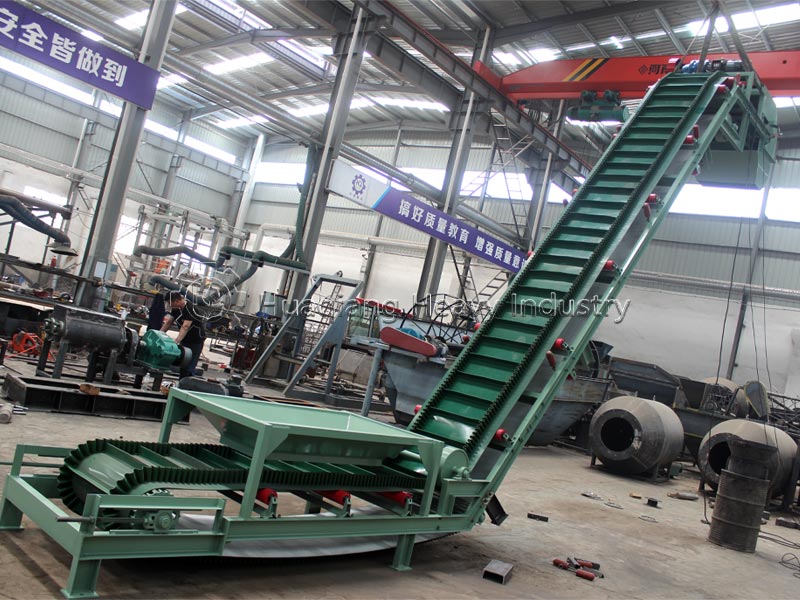
Large Angle Belt Conveyor
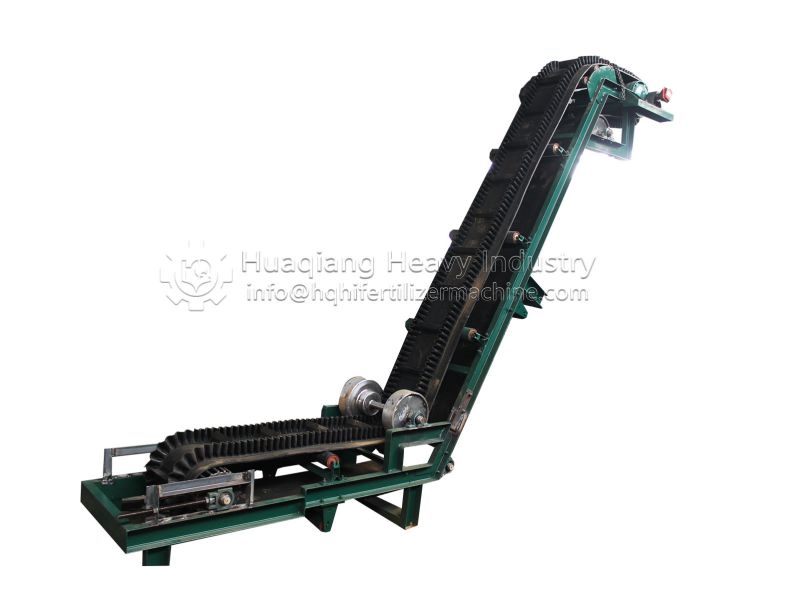
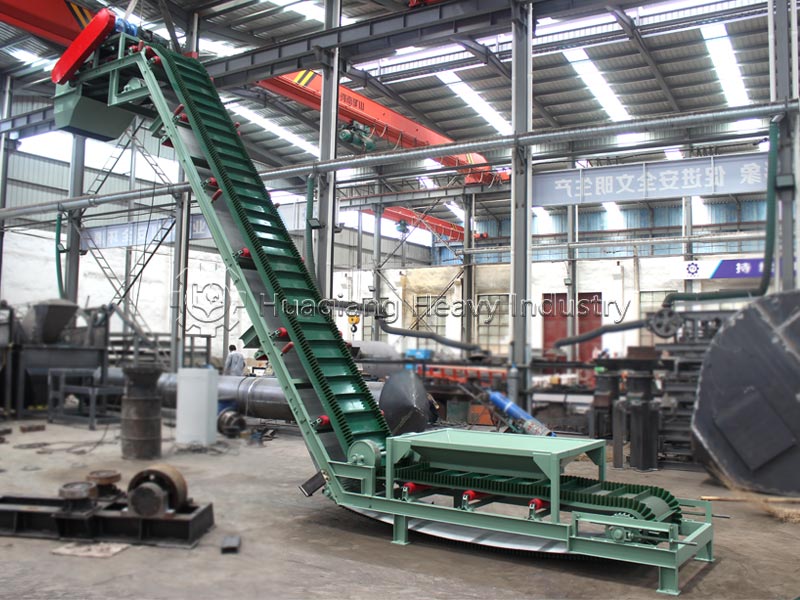
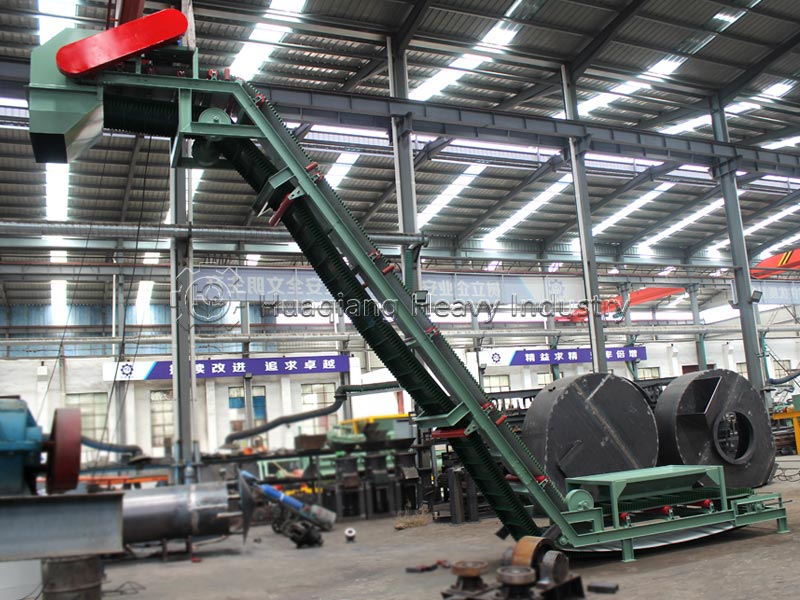
The large angle belt conveyor is specifically designed to solve the challenge of vertically transporting materials from a lower to a higher level within fertilizer production lines. Fertilizer processing facilities often require equipment to be positioned at varying elevations—for instance, lifting pre-mixed materials from ground level to the inlet of an elevated granulator. This conveyor handles such tasks at near-vertical angles; the corrugated sidewalls and transverse cleats on the belt act as a series of small, moving hoppers that securely cradle and lift the material. Offering reliable operation and easy maintenance, this equipment is essential for achieving a multi-level layout and maximizing spatial efficiency in fertilizer production lines.
Working Principle
Material is fed onto the conveyor belt at the lower inlet. The belt assembly—comprising a base belt, corrugated sidewalls on both sides, and transverse cleats—forms a series of open-topped compartments. A motor drives the head pulley to move the belt upward, with the transverse cleats retaining the material and carrying it along. The corrugated sidewalls act as barriers, preventing material spillage during the steep ascent. Upon reaching the top and passing over the head pulley to descend, the material is discharged into the outlet hopper. The empty belt then returns to the lower section via the return run, completing the conveying cycle.
Equipment Components
Sidewall Conveyor Belt: The core component; a single integrated structure formed by vulcanizing a base belt (to bear tensile force), corrugated sidewalls (for lateral containment), and transverse cleats (to push the material).
Drive and Bend Pulleys: The drive pulley transmits power and features a wear-resistant, anti-slip rubber lagging; bend pulleys are used to alter the belt’s running direction.
Idler Assemblies: Carrying-side idlers support the weight of the belt and material; return-side idlers support the empty belt; hold-down rollers are installed on steep-incline sections to prevent belt uplift.
Frame Structure: A welded structural steel framework comprising a lower horizontal section, an inclined lifting section, and an upper horizontal discharge section.
Tensioning Mechanism: Located at the tail pulley; maintains proper belt tension via adjustment screws or counterweights.
Feeding and Discharge Devices: A feed chute at the loading end prevents spillage; a discharge hopper at the unloading end directs material flow.
Safety Guards: Protective mesh or guards are installed on both sides of the belt, and protective covers enclose the drive components.
Operational Precautions
Before startup, inspect the belt for misalignment, tearing, or excessive wear, and check that cleats and sidewalls are intact. Start the equipment unloaded; begin feeding material only after normal operation is established.
Feeding must be uniform and continuous; avoid sudden, massive loads that could stall the belt or cause spillage. Never stop the conveyor while it is loaded with material; stop the feed first, allow the belt to clear completely, and then shut down the main unit.
Monitor the belt for misalignment during operation; if misalignment occurs, adjust the tail tensioning screws promptly to correct it. Ensure the belt does not become jammed by material or scrape against other components during operation.
Regularly inspect the bonding areas of sidewalls and cleats for cracking and repair any issues immediately. Material temperature should not exceed 80°C; heat-resistant belts must be used for high-temperature materials.
Have Any Problem? Please, Contact
Integrity
Adhere to honesty and trustworthiness, be responsible to customers, employees, partners, and society, and establish long-term trust relationships.
Win win
Establish win-win relationships with all stakeholders such as customers, suppliers, and employees to share the fruits of enterprise development.