
Limitations of disc granulation and roller press granulator production lines
Disc granulation and roller compaction granulation are two common processes; while each has its specific applications, both also possess distinct limitations.
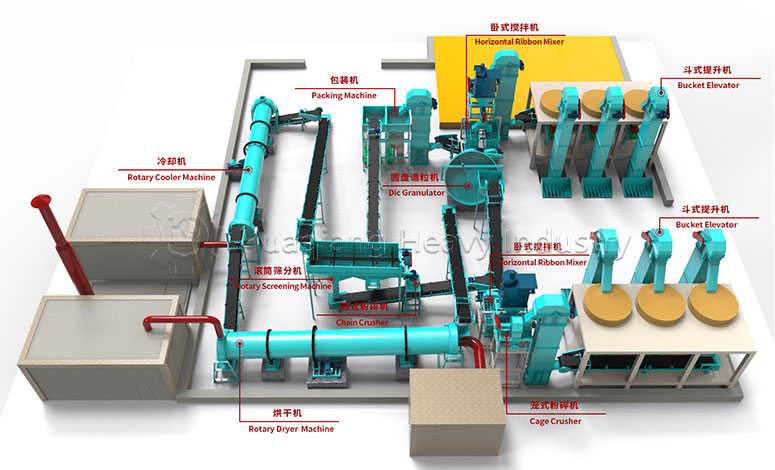
Limitations of disc granulation production lines: Disc granulation relies on the rotation of the disc to tumble materials into granules, making the process sensitive to moisture content and material viscosity. Excessive moisture causes material to stick to the disc, necessitating frequent shutdowns for cleaning, while insufficient moisture hinders granulation and increases the recycle rate. Granulation efficiency is often suboptimal for high-concentration NPK formulas or low-viscosity inorganic materials, resulting in limited granule strength and a tendency to generate fines during transport. As a wet process, it requires subsequent drying, entailing significant energy consumption and auxiliary investment. Single-unit capacity is limited, making it better suited for small-to-medium-scale production involving diverse product varieties rather than large-scale continuous production, where it lacks economic advantages.
Limitations of roller press granulator production lines: Roller compaction is a dry extrusion process that imposes strict requirements on material moisture and particle fineness. High moisture leads to slippage and sticking to the rollers, whereas low moisture results in loose granules with insufficient strength; inadequate fineness significantly reduces the forming rate. Relying on high-pressure forced forming, the granules lack the sphericity achieved by drum or tower granulation processes, requiring caution for products where visual appeal is critical. Roller surface wear represents an ongoing cost, necessitating periodic repair or replacement during long-term operation. Production capacity is generally lower than that of a drum granulation line of similar scale; while formula switching is flexible, the system is prone to clogging when handling highly viscous or fibrous materials.
In summary, disc granulation lines are suitable for small-to-medium-scale operations, organic materials, or low-to-medium concentration formulas, whereas roller press lines are ideal for dry processing, high-concentration products, and small-batch, multi-variety scenarios. Neither is a universal solution; equipment selection should prioritize raw material characteristics, capacity planning, and product positioning rather than blindly pursuing the advantages of a single process.