
(FAQ)What are the common mistakes made when operating a BB fertilizer mixer?
Although BB fertilizer mixers appear simple to operate, there are several easily overlooked pitfalls in actual use. While these errors may not cause immediate mechanical failure, they can insidiously reduce mixture uniformity and increase granule breakage rates, ultimately compromising the quality of the finished product.
“Longer mixing time equals better uniformity.” Many operators assume that mixing for a little longer is always better. In reality, prolonged tumbling of BB fertilizer granules within the drum intensifies inter-particle friction, leading to a significant increase in the proportion of fines (powder). Continuing to mix after the required uniformity is achieved yields negligible benefits while causing cumulative damage. A mixing time of 3 to 5 minutes is usually sufficient; the exact duration should be determined based on measured uniformity.
Using the same rotation speed for all formulas. Raw materials in different formulas vary significantly in specific gravity. High-potassium formulas contain a high proportion of heavy granules, requiring a slightly higher rotation speed to prevent settling; conversely, for urea-based formulas, excessive speed accelerates granule breakage. Mixing intensity should be adjusted according to the specific characteristics of the formula.
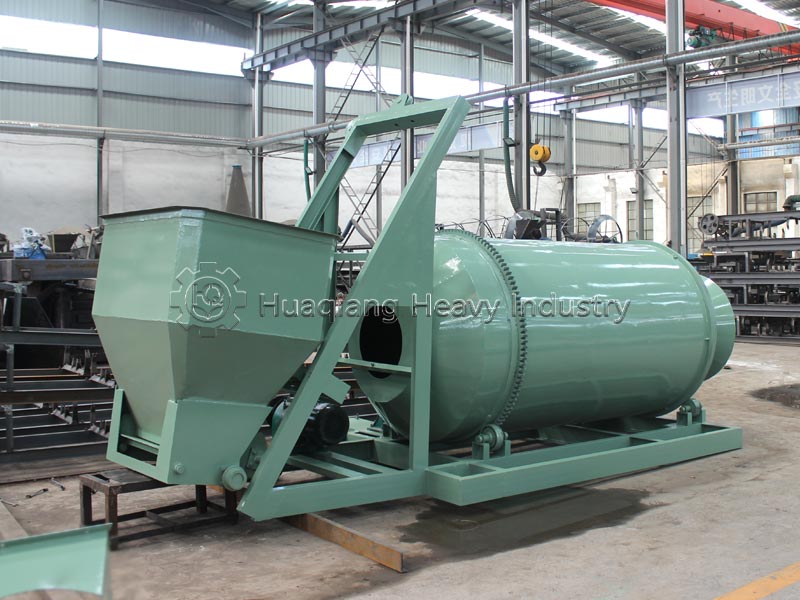
Ignoring the material loading sequence. The order in which heavy and light materials are loaded significantly affects mixing results. The proper approach is to load light, low-flowability materials first, followed by heavy granules; this allows the heavy granules to disperse gradually during the mixing process, minimizing accumulation at the bottom.
Incomplete cleaning between batches. Residual material, however small in quantity, can directly contaminate the next batch. This is particularly problematic with materials of contrasting colors, where residues can lead to an uneven appearance in the finished product. After each batch, the access hatch should be opened to clean the drum walls and any “dead zones” near the discharge outlet.
Focusing solely on uniformity while ignoring granule breakage. Achieving the target uniformity does not guarantee a qualified product. If the breakage rate is too high, the amount of powder will increase further during packaging and transport, negatively affecting application performance. Breakage rates should be monitored regularly, and rotation speed or mixing time adjusted promptly if anomalies are detected.
Avoiding these pitfalls does not require complex technical modifications; the key lies in implementing standardized operating procedures and accumulating operational data. By getting every detail right, the BB fertilizer mixer can consistently produce high-quality fertilizer.