
(FAQ)Do differences in the NPK fertilizer production process affect product quality?
Many industry practitioners mistakenly believe that as long as the raw material formula is the same, the quality of NPK fertilizer will be identical, regardless of the production process used. In reality, even with an identical formula, variations in production steps and process parameters can alter nutrient uniformity, granule strength, and storage stability—directly leading to differences in the quality of the final product.
Ingredient mixing. Even when using the same raw materials, insufficient mixing time or inadequate mixing intensity can result in an uneven distribution of nutrients. Some granules may end up with an excess of certain nutrients, while others may lack phosphorus or potassium, leading to inconsistent crop growth after application. Only through precise process control can all raw materials, including secondary nutrients and micronutrients, be thoroughly and uniformly blended.
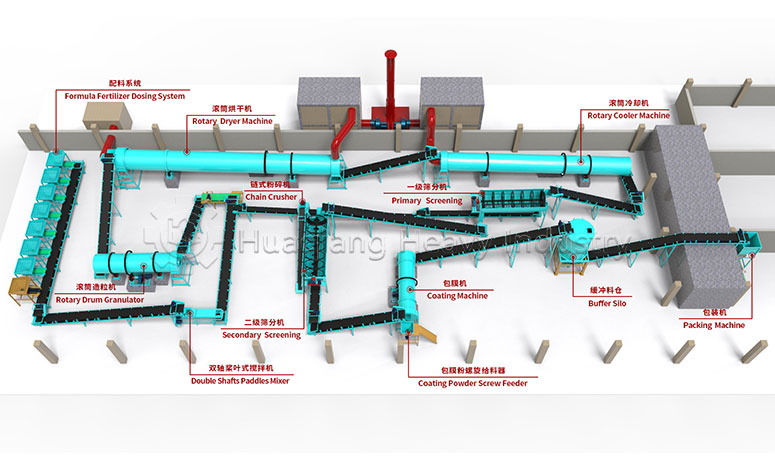
Fluctuations during granulation. Changes in moisture content, the ratio of recycled material (fines), or equipment rotation speed during the granulation stage directly affect the quality of the granules. Excessive moisture results in soft, fragile granules, while insufficient moisture leads to an increase in dust. Poor control can also produce a large number of irregularly shaped granules, which are highly prone to breaking down into powder during handling and transport.
Drying and cooling. If the drying temperature is too high, nitrogen may be lost through volatilization; if it is too low, the final product may exceed moisture limits, causing it to absorb moisture and clump during storage. Furthermore, if fertilizer is packaged without being sufficiently cooled, the residual internal heat can accelerate moisture re-absorption, thereby shortening the product’s shelf life.
It is clear, therefore, that the NPK fertilizer production process quality is not determined solely by its formula. Any process deviation—whether during ingredient mixing, granulation, or drying and cooling—will inevitably impact the final product. To consistently produce high-quality compound fertilizer, standardized control must be implemented across the entire production process.