
How effective is a disc granulation production line for manufacturing NPK compound fertilizers?
While a disc granulation production line is a viable option for NPK compound fertilizer production, it is not a universal solution; its suitability depends on your product positioning and production scale.
It is best suited for specific scenarios: an annual output of 10,000 to 50,000 tons, formulations with a total nutrient content of 25% to 35%, and operations that require frequent switching between different product varieties. With lower equipment investment, intuitive operation, and easy cleaning during formula changes, it is an accessible choice for startups or companies with a diverse product portfolio.
In terms of practical advantages, the granulation process is visible, allowing operators to assess moisture levels and granule formation based on their experience—making it easy to learn and adjust. For low-to-medium concentration formulas, it produces well-rounded granules that meet the aesthetic standards of most markets. The overall system configuration is simple, making routine maintenance relatively straightforward.
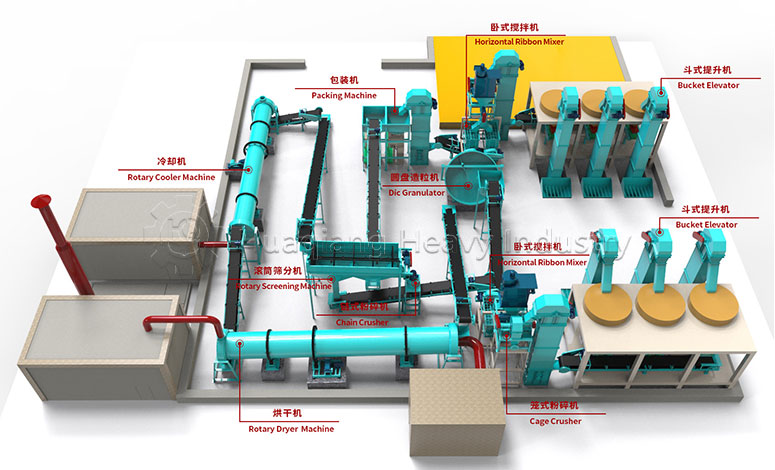
However, there are notable drawbacks. When the total nutrient content exceeds 40%, the material often lacks sufficient adhesive components, leading to a significant drop in the granulation rate and an increase in the volume of recycled material (fines), which hurts economic efficiency. Moisture control is highly sensitive: too much moisture causes the material to stick to the disc, while too little prevents proper granule formation. As a wet granulation process, it requires downstream drying and cooling equipment, which entails significant energy consumption and capital investment. Furthermore, the capacity of individual units is limited, making it less stable than rotary drum granulation production lines for large-scale, continuous production.
Key operational factors include: ensuring a consistent feed rate; using fine atomization for moisture addition to prevent localized over-wetting; fine-tuning the disc’s inclination angle and rotational speed based on the specific formula; and keeping the recycle system clear so that undersized fines are promptly returned to the process. When these details are managed correctly, the granulation rate and product quality can be maintained at a consistently acceptable level.
In summary, a disc granulation line is well-suited for small-to-medium-scale production of low-to-medium concentration, multi-variety NPK fertilizers. If your goal is high-capacity production or high-nutrient formulations, rotary drum granulation or fertilizer granules compaction processes would be more appropriate. The key to selecting the right technology is not determining which process is “better” in the abstract, but rather ensuring it aligns with your specific product strategy and raw material characteristics.