
Selecting equipment to complement a flat die pelleting machine: Crushers and mixers
Flat die pelleting machines utilize a dry-extrusion process at ambient temperature. Since the condition of the feed material directly determines the granulation rate, the selection of crushers and mixers must be handled with care.
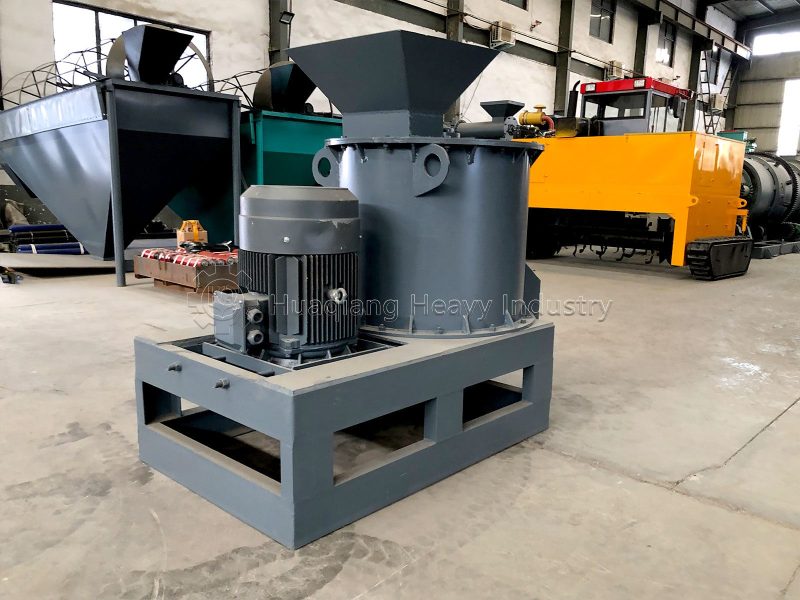
For crushing, a half-wet material crusher is a common choice. Organic fertilizer raw materials—such as composted manure, biogas residue, or spent mushroom substrate—often have high moisture content and high stickiness, which can easily clog standard crushers. Half-wet crushers feature anti-adhesion blades and replaceable screens, capable of processing material to a fineness of 20–40 mesh. If the material is too coarse, the resulting granules will be loose; if it is too fine, it increases extrusion resistance and may cause the material to stick to the die. Properly controlling the fineness is essential for smooth operation of the flat die pelleting machine.
For mixing, a horizontal ribbon mixer is generally well-suited. Its dual-layer (inner and outer) ribbon design promotes convective flow and provides gentle mixing, making it ideal for evenly distributing microbial agents or trace/micro-nutrients throughout organic materials. If the formulation contains a high proportion of inorganic particles with significant differences in specific gravity, a double shaft paddle mixer may be preferred; it offers faster mixing and higher uniformity, though the rotational speed must be controlled to avoid excessive shearing. Moisture levels can also be adjusted during the mixing process to ensure the material reaches a moisture content of 20%–30% before entering the flat die pelleting machine.
When integrating these machines, it is crucial to ensure that their production capacities are well-matched. The crusher’s throughput should be slightly higher than that of the mixer, and the mixer’s output should align with the capacity of the flat die pelleting machine to prevent material shortages or bottlenecks. Processed material should not be left to sit for long periods; once mixed, it should be granulated as soon as possible. Between batches, screens, vessel walls, and dies must be cleaned to prevent cross-contamination.
In summary, the effective integration of a flat die pelleting machine with a half-wet material crusher and a horizontal ribbon or double shaft paddle mixer hinges on the precise alignment of material fineness, moisture content, mixture uniformity, and production capacity.