
Double axis paddle mixers: The “efficiency champion” of fertilizer mixing
With their symmetrical, staggered paddle structure, double axis paddle mixers play an irreplaceable role in fertilizer mixing production. Adaptable to diverse applications such as BB fertilizers, organic fertilizers, and compound fertilizers, they are core equipment for high-quality fertilizer production.
Strong convection mixing, balancing uniformity and efficiency. The twin shafts rotate in opposite directions, and the staggered paddles create a multi-dimensional convection field, rapidly blending raw materials with different specific gravities and particle sizes. The mixing uniformity far surpasses that of single-shaft equipment, and the nutrient variation coefficient can be controlled within 3%. The mixing cycle is shortened by more than 40%, meeting the batch processing needs of NPK fertilizer production lines and significantly increasing overall capacity.
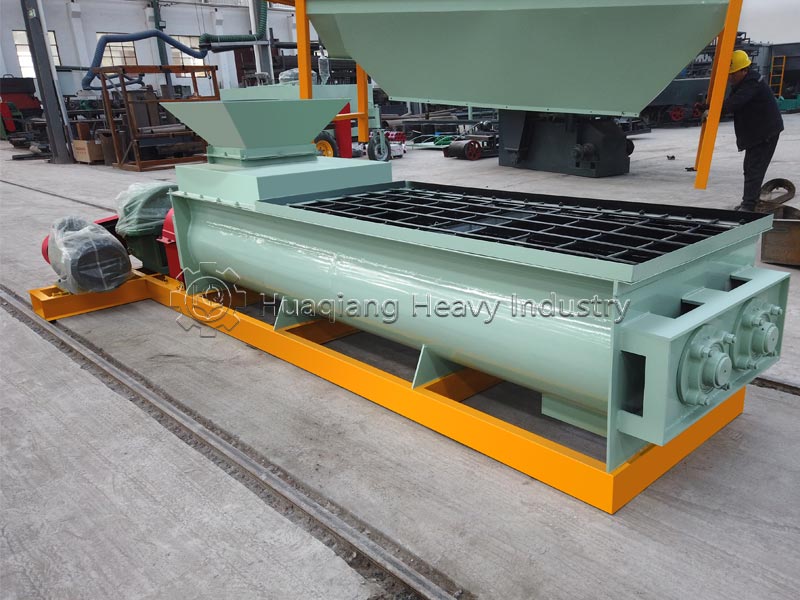
Outstanding adaptability, solving complex raw material challenges. Compared to ordinary fertilizer mixers, it can easily handle high-humidity, highly viscous raw materials (such as well-rotted organic fertilizers and sludge-based fertilizers). The special angle design of the paddles prevents adhesion to the walls and does not damage the properties of the granular raw materials. In BB fertilizer production, it can achieve uniform mixing of dry powder and small amounts of additives, ensuring precise formulation.
Low-loss and energy-saving, suitable for large-scale production. The extremely small gap between the impeller and the machine cavity results in minimal raw material residue and a material utilization rate exceeding 98%. The dual-shaft coordinated operation saves approximately 25% more energy than traditional equipment. It can also seamlessly integrate with screening and granulation equipment, achieving integrated mixing and pretreatment, simplifying the process.
In summary, the double shaft paddle mixer, with its structural advantages and high efficiency, versatility, and low consumption, has become a powerful tool in fertilizer mixing, stably ensuring fertilizer quality and helping fertilizer production upgrade towards higher efficiency and precision.