
How does a 10-ton/hour NPK fertilizer production line improve agricultural productivity?
The 10-ton/hour NPK fertilizer production line, with its core advantages of large-scale production, standardized quality, and customized adaptation, breaks through traditional production bottlenecks. Through mature NPK compound fertilizer granulation technology, coupled with professional fertilizer granulators and mixers, it empowers agriculture from the fertilizer supply side, comprehensively improving productivity and supporting high-quality and increased yields in large-scale planting.
Large-scale production solves the fertilizer shortage problem and ensures stable supply. This production line can operate continuously around the clock, with a daily capacity of 240 tons, efficiently meeting the fertilizer needs of large-scale farmland and large-scale bases. It avoids delays in planting due to insufficient fertilizer supply, laying a solid foundation for orderly agricultural production and significantly improving planting efficiency.
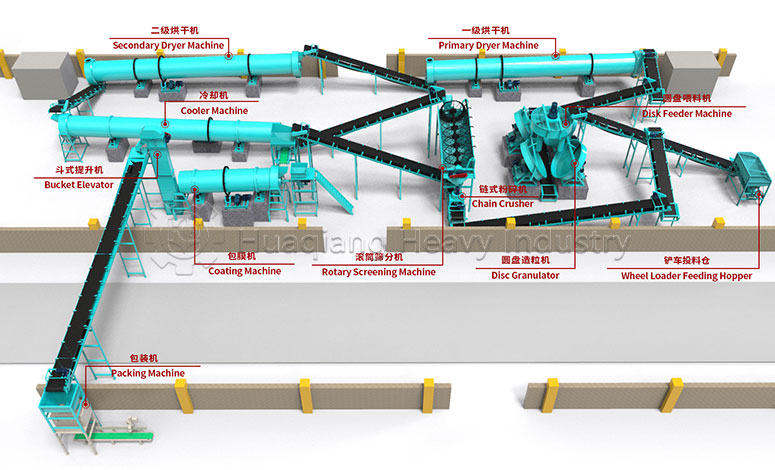
Standardized quality lays a solid foundation for increased yields and reduces planting losses. The production line utilizes precise ingredient proportioning and scientific granulation technology, coupled with a fertilizer mixer to ensure thorough mixing of raw materials. The resulting compound fertilizer granules are uniform, nutrient-balanced, and release nutrients steadily, effectively preventing uneven crop growth and nutrient deficiency, reducing management costs, and improving crop yield and quality.
Customized formulations cater to diverse needs and optimize nutrient supply. It can customize nitrogen, phosphorus, and potassium ratios according to different crops and soil conditions, adapting to the nutrient requirements of various crops. It can also be linked with an organic fertilizer production line to produce compound organic fertilizer, improving soil fertility, achieving sustainable land use, and enhancing long-term agricultural productivity potential.
In summary, this production line focuses on three dimensions: stable supply, improved quality, and customized formulation. It simplifies the fertilization process, reduces labor and time costs, and achieves “fertilizer suitable for crops, sufficient quantity and excellent quality,” comprehensively driving efficient improvement in agricultural productivity.