
Disc granulation process: The transformation from powder to granules
In the fields of fertilizer, pesticide, and mineral processing, disc granulators are hailed as “egg-laying plates.” This seemingly simple machine demonstrates the intricate process of powder agglomerating into granules.
1.Material Input: Granulation begins with uniform feeding. Finely ground powdered raw materials, mixed according to the formula, are stably conveyed into the rotating disc by a feeder. Simultaneously, a spray system atomizes liquids—water, binders, or steam—into the material flow, providing adhesive force for powder agglomeration. The stable coordination of feeding and spraying is the foundation for uniform granules.
2.Nucleation Stage: Under the influence of centrifugal force, friction, and gravity generated by the rotating disc, the material moves along a parabolic trajectory. When droplets encounter fine powder, liquid bridges are formed between the particles, pulling several particles together into tiny “nuclei.” These nuclei are the starting point for particle growth, and their number and distribution determine the final particle size range.
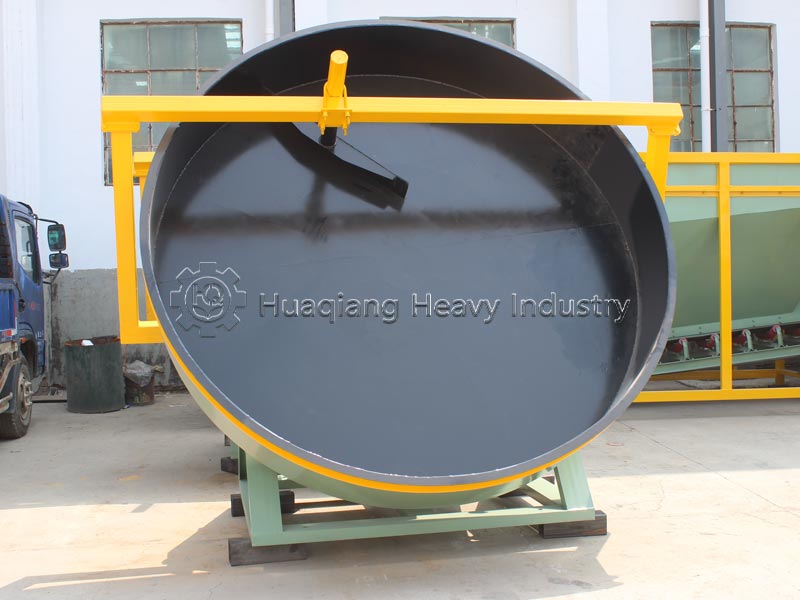
3.Growth Stage: Small crystal nuclei continuously roll on the disc surface, adsorbing surrounding dry powder layer by layer like a snowball. The sprayed liquid continuously wets the surface, and the compression effect makes the particles increasingly dense. The tilt angle and rotation speed of the disc are adjusted to allow the particles to be naturally graded on the disc surface: large particles float to the top, while small particles sink to the bottom to continue growing.
4.Grading and Unloading: When the particles grow to the target particle size, their weight is sufficient to overcome the friction at the edge of the disc, and they naturally overflow from the edge of the disc, completing the unloading process. Ungrown particles remain in the disc and continue rolling. This self-screening mechanism allows the disc granulation process to obtain highly uniform products without additional sieving.
The charm of disc granulation technology lies in its openness and adjustability. The operator visually observes the load on the disc surface and the state of the particles, adjusting the spray volume or tilt angle as needed. This “visible and controllable” process allows the powder to transform into particles during rotation.