
Key features of fertilizer mixer machines used in roller press granulator production lines
Roller compaction granulation is a dry, high-pressure forming process that imposes strict requirements on feed uniformity, moisture content, and particle fineness. Consequently, the fertilizer mixer machines used in these lines are not standard mixing equipment; rather, they feature specialized designs in terms of both structure and functionality.
Balanced mixing intensity and shear control. Materials must be thoroughly blended before entering the compactor; however, excessive shear must be avoided to prevent heat generation or the creation of an overabundance of fine powder. These mixers typically employ a forced-convection design, ensuring uniform blending within a short timeframe while precisely controlling the linear velocity of the mixing blades and the duration of the mixing process.
Precise moisture regulation capabilities. Roller compaction is highly sensitive to moisture content: excessive moisture can cause material to stick to the rollers, while insufficient moisture leads to loose, fragile granules. These mixers are generally equipped with spray nozzles for liquid addition, designed to produce a fine mist and ensure even distribution. Some systems are even integrated with in-line moisture sensors, keeping the moisture content of the mixture within the optimal process range.
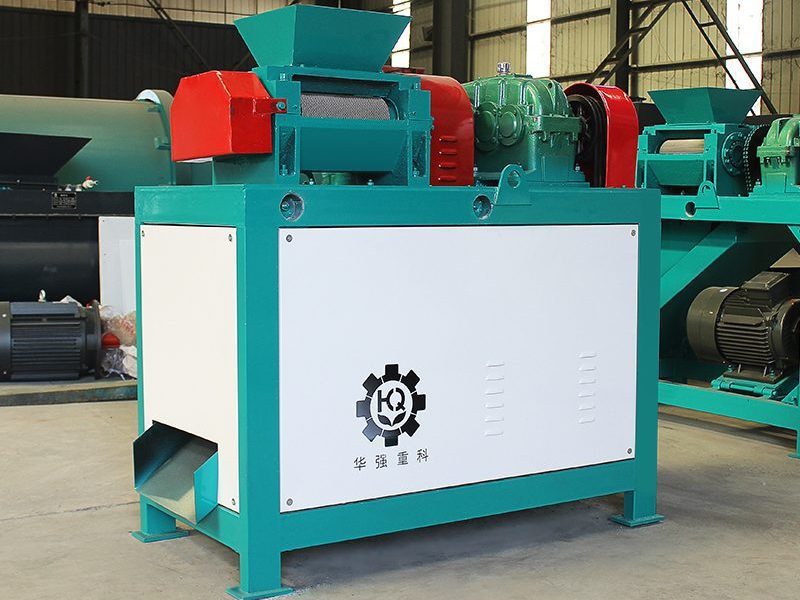
Enhanced wear resistance and anti-adhesion properties. Since the materials processed in dry granulation are primarily powders, long-term operation can cause significant wear to the mixing chamber and internal components. Surfaces in contact with the material are often reinforced with wear-resistant liners or hard-facing weld deposits. Furthermore, the internal walls and discharge ports are designed to minimize “dead zones,” preventing the accumulation or sticking of damp, cohesive materials.
Stringent sealing and dust control requirements. Powder mixing often generates dust; therefore, these mixers typically feature a fully enclosed design with dedicated ports for connection to a facility-wide dust collection system. This improves the workshop environment and reduces material loss.
In summary, the core characteristics of mixers designed for roller press granulator production lines are tailored to the demands of dry-process extrusion: they ensure uniform blending, precise moisture control, wear resistance, anti-adhesion, effective sealing, dust containment, ease of cleaning, and stable material feed—all of which are essential for maintaining high granulation yields and superior granule quality.