
Current status of dry granulation using flat die pelleting machines in organic fertilizer production
The dry granulation technology employed by flat die pelleting machines is widely used in organic fertilizer production and is gradually becoming a mainstream process, particularly in small- to medium-scale operations.
The core advantage of dry granulation is that it requires no water or chemical binders; materials are formed directly through mechanical extrusion. This feature resolves several pain points associated with wet granulation. Wet granulation results in granules with a moisture content of around 40%, necessitating large-scale drying equipment, whereas granules produced via dry granulation have a moisture content below 25%, allowing them to cool naturally and be packaged without drying in most cases.
Regarding product quality, dry extrusion is a physical process conducted at ambient temperatures with minimal heat generation; this effectively preserves organic matter and beneficial live microorganisms—a factor of particular importance for bio-organic fertilizer production. Furthermore, the extruded granules are dense and strong, offering excellent resistance to breakage and facilitating storage and transport.
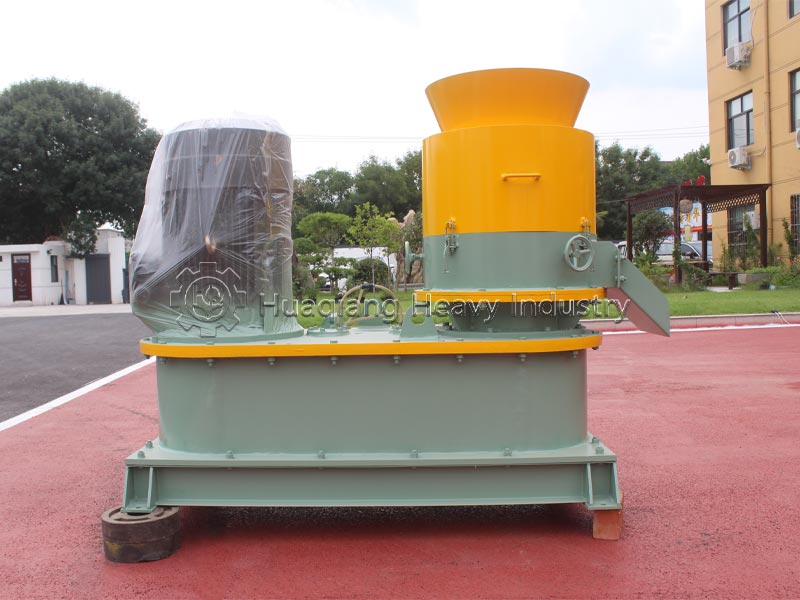
Dry granulation offers broad adaptability to raw materials, excelling particularly with materials that are difficult to process using wet methods. Common suitable materials include: composted livestock and poultry manure (cattle, chicken, pig, sheep, etc.); fibrous agricultural waste such as straw, rice husks, and peanut shells; industrial organic waste like mushroom residue, distillers’ grains, and sugar beet pulp; and natural organic mineral materials such as humic acid and peat.
In actual production, it is essential to control the moisture content of the material before it enters the granulator—ideally between 20% and 30%—and to ensure a grinding fineness of 80 mesh or higher to guarantee a good granulation rate and granule appearance. Properly adjusting moisture and fineness parameters for different raw materials can further improve the yield of the finished product.
Overall, dry granulation using flat die pelleting machines—characterized by a simple process, energy efficiency, and moderate investment costs—effectively meets the organic fertilizer industry’s demand for low-cost, high-efficiency production models and is gaining increasingly widespread market recognition.