
What is the final quality of fertilizer produced by a disc granulation production line?
Evaluating the quality of fertilizer from a disc granulation production line cannot be simplified into a binary “good” or “bad”; rather, it must be assessed based on specific performance indicators. In general, for low-to-medium concentration formulations and small-to-medium-scale production, the process can consistently yield products that meet national standards. However, in high-concentration or large-scale production scenarios, quality fluctuations tend to become more pronounced.
The appearance and particle size uniformity of the granules are generally good. As materials roll within the disc to form spheres, they achieve a high degree of roundness—particularly with low-to-medium concentration formulations—and particle size can be maintained within a target range through screening. The resulting product has a uniform appearance and good commercial appeal.
Particle strength is moderate, and the rate of pulverization (fines generation) requires careful management. Strength depends primarily on the binding properties of the materials and the drying process; while usually sufficient for standard packaging and transport, these granules are generally less dense than those produced via drum or tower granulation. If drying is inadequate or the formulation lacks sufficient adhesiveness, the granules may break down into powder during storage and transport—an issue that must be mitigated through screening and coating.
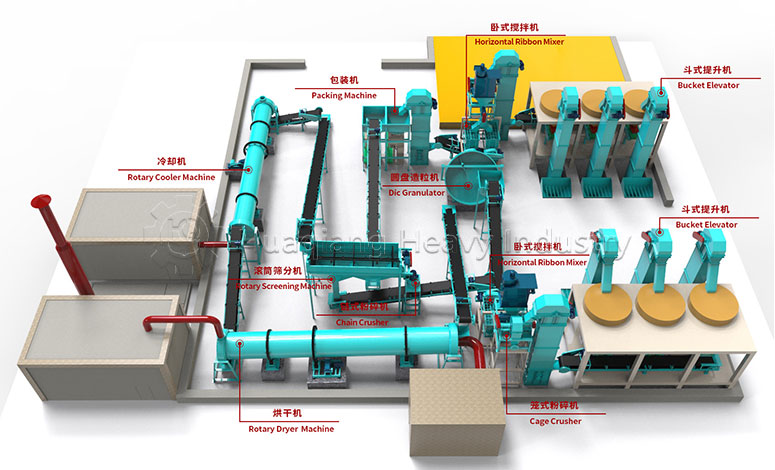
Nutrient uniformity is determined by the upstream proportioning and mixing stages. The disc granulator itself does not alter nutrient distribution; rather, the precision of the initial batching and the thoroughness of the mixing are the decisive factors. If upstream controls are effective, the nutrient variation coefficient of the final product will meet standards; if not, the granulation stage cannot compensate for these shortcomings.
Moisture content and storage stability are critical. Because the wet granulation process results in high initial moisture content, the product must be dried and cooled before packaging. Improper control of drying temperature or duration can lead to granule cracking, reduced strength, or caking after packaging.
Batch-to-batch consistency is highly dependent on operator experience. The process is sensitive to adjustments in moisture levels, feed rates, and the tilt angle of the disc. Without sufficient operational expertise, quality may fluctuate between batches; therefore, standardized operating procedures and the systematic recording of process parameters are essential for maintaining consistent quality.
In summary, a disc granulation production line is well-suited for the production of low-to-medium concentration fertilizers. Its primary strengths lie in the appearance and size uniformity of the granules, while its weaker points include particle strength and moisture control.