
(FAQ)Which materials are best suited for mixing with a double axis paddle mixer?
A double axis paddle mixer relies on paddles arranged in a staggered pattern on two parallel shafts to simultaneously create radial scattering and axial flow of materials, forming a three-dimensional circulating mixing effect. This unique mechanism determines its adaptability to different materials.
Dry powder granular fertilizer raw materials are the most suitable. Urea, monoammonium phosphate, potassium chloride, potassium sulfate, and other NPK inorganic salt crystals or powders have good flowability, similar density, and low moisture content, quickly forming a uniform convective mixture under the scattering action of the paddles. These materials are not prone to sticking to the walls and clumping, achieving a high degree of mixing uniformity within 3 to 5 minutes, with clean discharge and no residue.
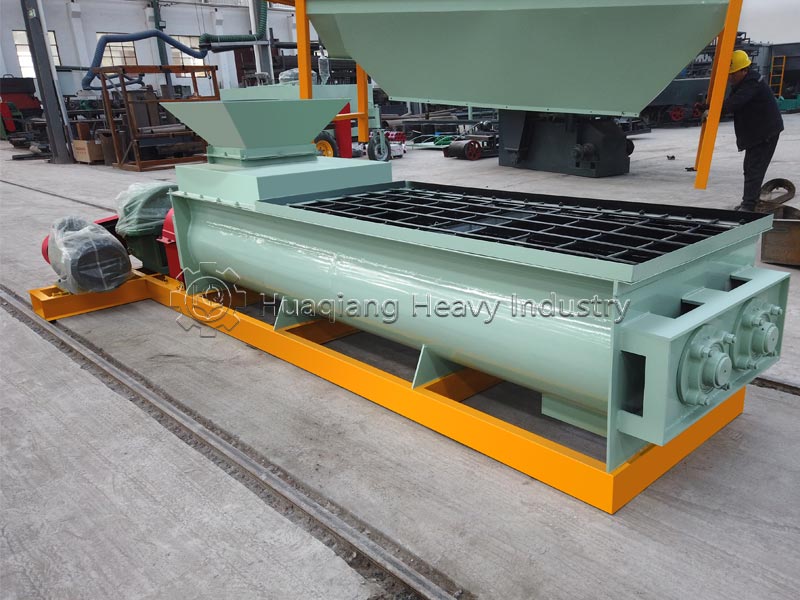
Materials containing a certain amount of moisture or slight viscosity are within a good suitable range. Preliminary fermented and pulverized organic materials, mixed powders with added binders, and compound fertilizer formulations with a moisture content of less than 10%, although their flowability is slightly inferior to dry powder, the strong shearing action of the paddles effectively breaks up slight clumps, ensuring uniform mixing. Simply extending the mixing time appropriately and discharging promptly will ensure stable operation.
High-fiber, high-moisture, and highly viscous materials have a limited range of compatibility. Fresh livestock and poultry manure, highly moist straw residue, and viscous paste-like materials have poor flowability and are prone to sticking to the mixing walls and clumping, which will significantly reduce the mixing effect and may even cause material sticking to the mixing shaft and mixing dead zones. If these materials need to be used, their moisture content must be reduced beforehand or diluted with dry powder, and the cleaning frequency should be increased.
In summary, double shaft paddle mixers are best suited for dry powder granules, and well suited for powders with moderate moisture content. High-moisture and highly viscous materials should be selected with caution.