
(FAQ)Why are flat die pelleting machines primarily used in organic fertilizer production?
Flat die pelleting machines are more commonly found in production lines for organic and bio-organic fertilizers rather than in large-scale NPK compound fertilizer plants. This is the result of a combination of factors: material characteristics, product positioning, and production scale.
Organic fertilizer raw materials are difficult to pelletize; flat die pelleting machines overcome this through forced extrusion. Materials such as livestock and poultry manure, straw powder, fungal residue, and humic acid often have high fiber content and insufficient adhesiveness. Granulation methods like disc or drum pelletizing rely on rolling and agglomeration, which require specific levels of stickiness and moisture; organic materials often struggle to form pellets this way, leading to high rates of “recycled” (unformed) material. Flat die pelleting machines, by contrast, use mechanical pressure between rollers and a die to force powdered material into cylindrical granules—a process that does not rely on the material’s inherent adhesiveness, effectively compensating for its limitations.
Organic fertilizers are sensitive to high temperatures, making ambient-temperature extrusion a better fit. For bio-organic fertilizers, the core requirement is maintaining the activity of functional microorganisms, while standard organic fertilizers also need to preserve their organic matter content. Wet granulation methods require subsequent drying, but high temperatures can inactivate microorganisms and cause the loss of organic matter. Flat die pelleting machine is a dry, ambient-temperature process; it results in minimal temperature increases, eliminates the need for a drying stage, and is therefore much gentler on heat-sensitive materials.
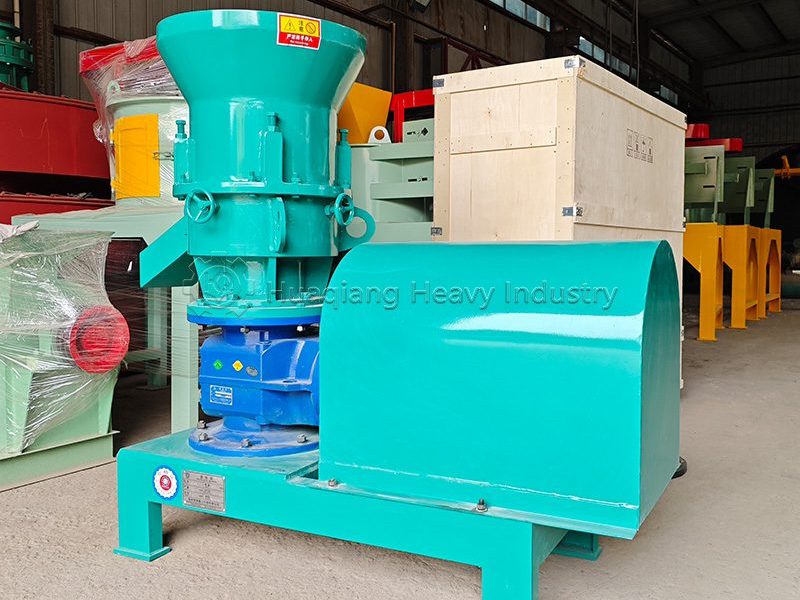
Organic fertilizer production tends to be decentralized, and the investment threshold for flat die pelleting machines is well-suited to this landscape. Many such projects are small- to medium-scale, utilizing localized raw materials and producing a wide variety of products, each in relatively small batches. With their simple design, compact footprint, and intuitive operation, flat die pelleting machines are ideal for small-batch, multi-variety production.
Why, then, are flat die pelleting machines not the mainstream choice for compound fertilizers? NPK fertilizers require high nutrient concentrations, large-scale output, and highly spherical granules—areas where drum or tower granulation methods offer clear advantages. Flat die pelleting machines have limited per-unit capacity and produce cylindrical rather than spherical granules, making them less competitive in the mainstream compound fertilizer market.
In summary, the primary use of flat die pelleting machines in organic fertilizer production is the result of three converging factors: the specific characteristics of the raw materials, the need for low-temperature processing, and the requirements of the production scale.