
Double roller press granulator: Powder reshaping under high pressure
Among various granulation technologies, the double roller press granulator stands out—it requires neither water wetting nor heating drying; it uses only powerful mechanical pressure to directly “press” powder into granules.
The effectiveness of double roller extrusion largely depends on two details. First, precise control of the roller gap—too large a gap results in insufficient pressure, leading to loose and brittle flakes; too small a gap increases the equipment load dramatically, potentially causing jamming. Second, degassing the material—air trapped in the powder, if not promptly removed, forms an “air cushion” during extrusion, affecting the density of the flakes. Therefore, many models are equipped with pre-compression or venting devices in the feeding area to ensure optimal extrusion performance.
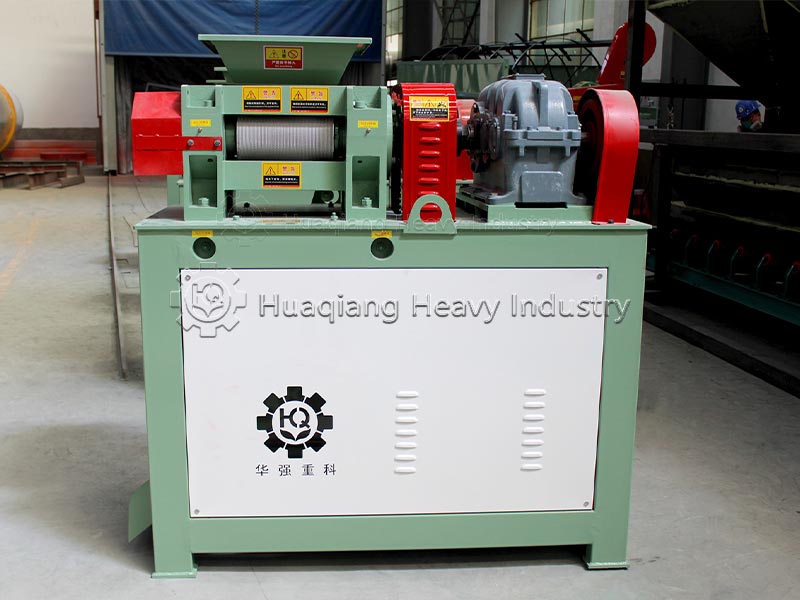
The biggest advantage of double roller press granulation lies in its “purely physical processing.” No water or binder is added during the entire process, eliminating the need for subsequent drying and significantly reducing energy consumption. Furthermore, because it does not involve high temperatures or moisture, it is particularly suitable for materials that are easily decomposed by heat or react easily with water, such as some pharmaceuticals, catalysts, and highly hygroscopic compound fertilizers.
Its limitation lies in the irregular particle shape—the finished product is mostly flat, broken lumps, less aesthetically pleasing than the spherical particles produced by disc granulators. However, for many industrial applications, a larger specific surface area is actually beneficial for dissolution or disintegration.
In the chemical, pharmaceutical, and some specialty fertilizer fields, the double roller press granulator occupies an irreplaceable position due to its unique dry forming capability.