
The scope of application for fertilizer granules compaction in NPK production
While fertilizer granules compaction technology is not the mainstream method for NPK compound fertilizer production, it is indispensable in specific scenarios. The process involves compressing powdered materials into sheets or strips using high-pressure twin rollers, followed by crushing and screening to obtain granules; the entire process requires neither added water nor drying.
It is best suited for two types of NPK production scenarios. The first involves high-concentration formulations; when total nutrient content exceeds 45%, the material lacks sufficient binding components, making granulation via rotary drums or pans difficult. In contrast, extrusion granulation relies on mechanical pressure for shaping, bypassing the limitations imposed by the material’s inherent adhesiveness. The second scenario involves small-scale production where drying facilities are unavailable. Eliminating the drying system significantly simplifies the production line and reduces both investment costs and energy consumption, making it ideal for processing capacities ranging from a few thousand to 20,000 tons per year, while also offering flexibility in switching formulations.
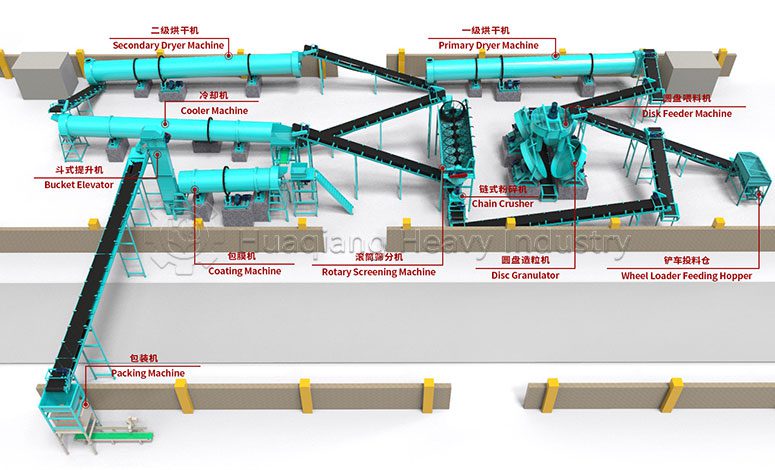
However, extrusion granulation also has clear limitations. It is sensitive to the moisture content and fineness of raw materials; excessive moisture causes sticking to the rollers, while insufficient fineness reduces granule strength. Granule sphericity is inferior to that produced by rotary drum or tower granulation processes, requiring a trade-off for products where visual appeal is critical. Furthermore, production capacity is generally lower than that of rotary drum lines of similar scale, making it less economically advantageous for large-scale, continuous production.
Consequently, fertilizer granules compaction serves as a complementary method rather than a replacement in NPK fertilizer production process. It is well-suited for high-concentration, small-scale, and multi-variety production needs. When selecting a granulation method, the key factor for enterprises is not merely pursuing the most advanced technology, but ensuring the process aligns with their raw material characteristics, capacity planning, and product positioning.