
Customized double shaft paddle mixer and screws conveyor complete material compatibility testing
A double shaft paddle mixer and its accompanying fertilizer screw conveyor, customized for a client in Malaysia, have successfully completed material compatibility testing. The equipment has been loaded onto a truck for transport to the port, from where it will be shipped by sea to Port Klang, Malaysia. The client’s process involves mixing and fermenting palm kernel meal, chicken manure, and a small amount of chemical fertilizer; the material has a moisture content of approximately 30% and exhibits high stickiness.
To address the specific characteristics of the material, our technical department implemented several targeted adjustments to the twin-shaft paddle mixer: the gap between the paddles and the vessel wall was kept within 5 mm to minimize residue; the paddle surfaces were reinforced with a wear-resistant overlay to extend service life; and a quick-opening access door was added to the bottom of the vessel to facilitate end-of-shift cleaning. The screws conveyor was customized to the client’s facility layout, featuring a 12-degree incline and a length of 6.5 meters. The screw flights were thickened and polished, and a quick-opening inspection port was installed on the casing to allow for easy monitoring of potential blockages. During the trial run, the system operated continuously for 3 hours using the actual material blend provided by the client. The mixer achieved a mixing uniformity of 94%, while the screw conveyor maintained a stable throughput of 12 tons per hour, with no signs of clogging or significant material adhesion.
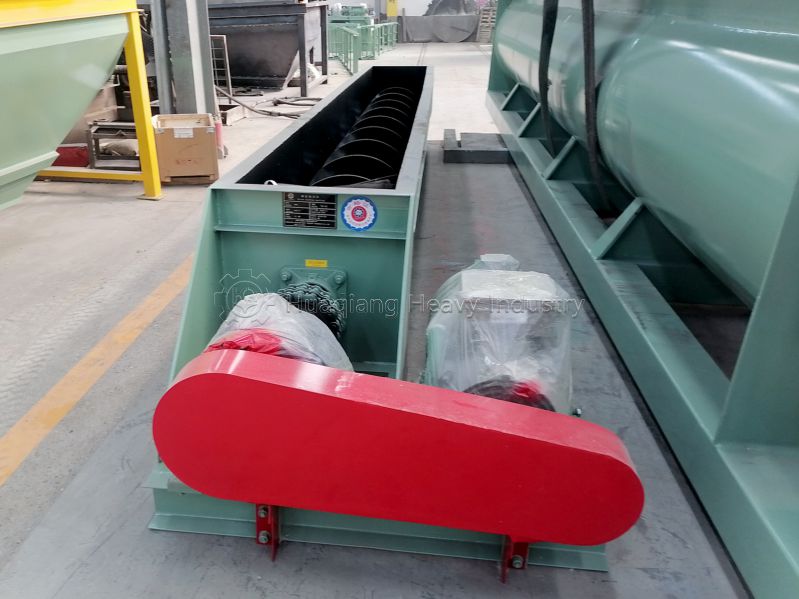
Prior to shipment, our quality inspection team verified the tension of the mixer’s drive belts, the integrity of the screws conveyor’s bearing housing seals, and the functionality of the emergency stop systems on both units, confirming that everything was in proper working order. For transport, the main mixer unit was secured using a steel frame, while the screws conveyor was disassembled into sections, with all flange connections sealed using plastic caps. Documentation—including installation drawings, operation manuals, and test records—was packed in a waterproof bag and included with the shipment. The transport vehicle has now departed our facility, en route to the port.