
What preparations are required for NPK fertilizer before using a double roller press granulator?
A double roller press granulator is a dry-process, high-pressure forming machine; the condition of the feed material directly determines the forming rate and the quality of the granules. Before startup, the NPK material must undergo the following preparations:
First, control the moisture content. This is the most critical prerequisite for dry-process extrusion. The moisture content of the material should generally be maintained between 2% and 8%, depending on the specific formulation. If the moisture content is too high, the material may slip, stick to the rollers, or even cause blockages during extrusion; if it is too low, the resulting granules will be loose and lack sufficient strength. Moisture levels should be adjusted during the mixing stage and verified through spot checks before the material enters the machine.
Second, ensure uniform fineness. Roller-press granulation relies on high pressure to create bonding forces between powder particles; the more uniform the fineness, the better the forming result. Typically, the material should be pulverized to a particle size of 20–40 mesh. If the particles are too coarse, granule strength decreases; if they are too fine, extrusion resistance increases. After pulverization, the material should be screened to remove large chunks and impurities, preventing hard objects from damaging the roller surfaces.
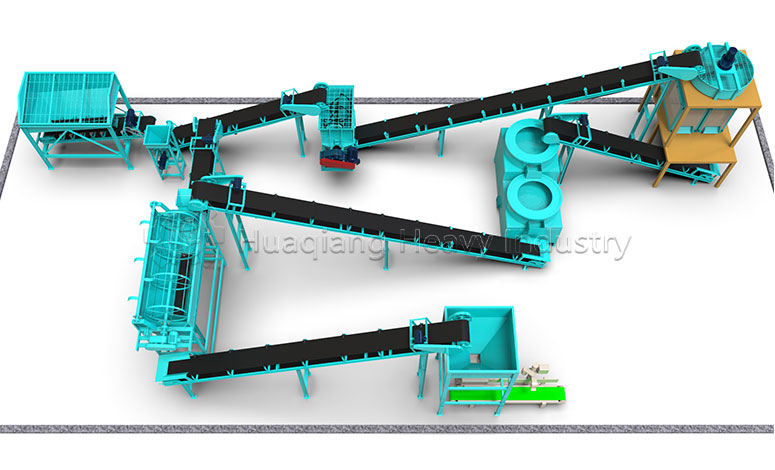
Third, ensure accurate proportioning and thorough mixing. In an NPK formulation, the ratios of urea, ammonium phosphate, potash, and fillers must be precisely measured to meet the target nutrient content. If the proportioning error exceeds limits, subsequent stable extrusion cannot correct the nutrient deviation. During the mixing stage, it is essential to ensure that all components are distributed uniformly.
Fourth, remove metal and hard impurities. Hard objects—such as iron filings or stones—mixed into the raw materials can damage the roller surfaces under the high pressure of the press. Before feeding, install iron-removal devices and screens to serve as a final safeguard.
Fifth, check the equipment status. Before startup, verify that the gap between the rollers meets the formulation requirements, the hydraulic system pressure is normal, and all drive components are properly lubricated. Conduct a no-load test run to listen for any abnormal sounds, and only begin feeding the material once everything is confirmed to be in proper working order.
In summary, the core preparations for roller press granulation are: controlling moisture, achieving the correct fineness, ensuring accurate proportioning, removing impurities, and verifying that the equipment is in good working condition. All five elements are essential; thorough preparation is key to ensuring the stable operation of the roller press granulator production line and the quality of the granules.