
Which type of fertilizer mixer is best suited for processing organic-inorganic compound fertilizers?
Organic-inorganic compound fertilizers contain both organic materials and inorganic chemical fertilizers. Because these components differ significantly in terms of specific gravity, particle size, moisture content, and stickiness, achieving a uniform mixture is more challenging than it is for single-component fertilizers.
The primary difficulties in mixing arise from material stratification and adhesion. Organic materials tend to be lighter and stickier, while inorganic fertilizer granules are heavier and flow more easily; in standard mixing equipment, this often causes heavier particles to sink and lighter materials to rise. Furthermore, organic materials with high moisture content can easily stick to the walls of the mixer, while inorganic salts may absorb moisture and form clumps. Consequently, the mixer must feature strong convective mixing capabilities, anti-adhesion designs, and the versatility to handle a wide range of moisture levels.
A horizontal ribbon mixer is the most practical primary choice. Its dual-layer (inner and outer) ribbon design creates a convective circulation, ensuring a gentle mixing process that avoids crushing inorganic granules while gradually breaking up sticky organic materials and interweaving them with the inorganic particles. The mixing chamber can be equipped with liquid spray nozzles to regulate moisture, preventing organic materials from becoming too wet and sticking to the walls—a feature particularly well-suited for formulations with a high proportion of organic components.
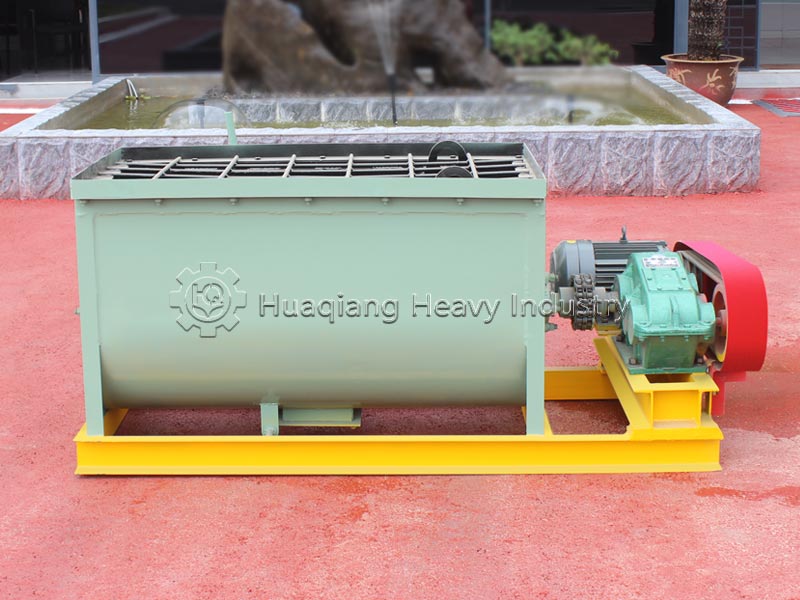
A double shaft paddle mixer can serve as a complementary option when high uniformity is required. In cases where inorganic fertilizers make up a large share of the mixture and there is a significant disparity in specific gravity, the forced convection provided by this type of mixer can achieve a more uniform distribution in a shorter amount of time. However, rotational speed and mixing duration must be carefully controlled to prevent excessive shearing, which could cause organic materials to heat up or inorganic granules to break apart.
Operational tips: Before feeding organic materials into the fertilizer mixer machine, ensure they are pulverized to a uniform fineness to prevent large chunks from tangling around the ribbons. If the moisture content is high, consider blending in dry inorganic raw materials before the full mixing process. Between batches, clean the chamber walls and the discharge outlet to prevent any residue from absorbing moisture and clumping. Additionally, the mixer’s throughput capacity should be matched to the requirements of the subsequent granulation or packaging stages.
In summary, a horizontal ribbon mixer is the preferred choice for processing organic-inorganic compound fertilizers, with double shaft paddle mixers serving as a supplementary option depending on the specific formulation.