
BB fertilizer production and the mixer: An inseparable process link
The BB fertilizer production process appears simple—merely the physical mixing of several granular fertilizers. However, a closer look at the production floor reveals that every line is inextricably linked to the mixer; the two are interdependent and mutually constraining.
Batching is the initial step. Once the electronic batching system weighs the raw materials according to the formula, the materials immediately enter the fertilizer mixer. No matter how precise the batching is, if the mixer fails to uniformly disperse materials that vary in specific gravity and particle size, the entire batch will fail to meet quality standards. The batching system determines the “theoretical value,” while the mixer determines the “actual value.”
The mixing stage directly exemplifies this connection. Through specific mechanical movements, the mixer causes urea, diammonium phosphate (DAP), and potassium chloride to undergo repeated tumbling, convection, and diffusion within the mixing chamber. A well-designed mixer can complete the process within 180 seconds while keeping granule breakage rates low. Inadequate mixer performance leads to consequences ranging from extended mixing times to excessive nutrient variance, potentially resulting in the scrapping of the entire batch.
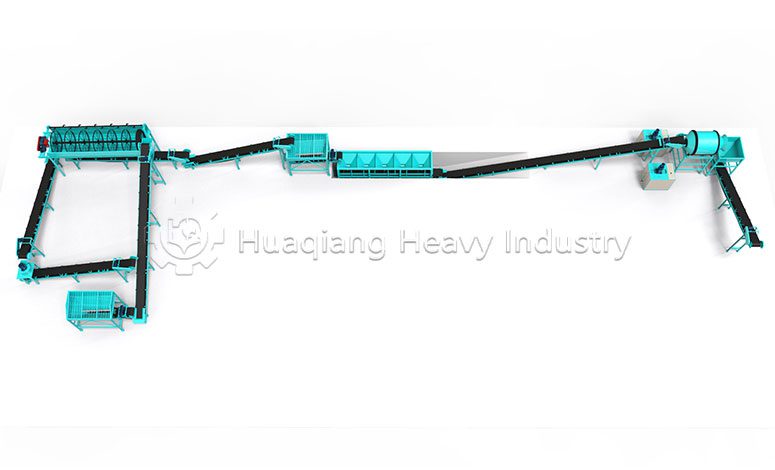
Equipment selection is also closely aligned with process requirements. For formulas with significant differences in specific gravity, double shaft paddle mixers are preferred to overcome segregation through forced convection; for products requiring pristine granule appearance, specialized BB fertilizer mixers are chosen to ensure gentle tumbling rather than aggressive agitation. Equipment selection is a direct response to product positioning.
Production line synchronization is equally critical. Upon completion of mixing, the material drops directly into the packaging machine’s hopper without intermediate buffering, requiring the operating rhythms of the mixer and the packaging machine to be perfectly matched. If the mixer is too fast, the packaging unit cannot keep up; if it is too slow, the production flow is interrupted.
The mixer serves as the core hub of the BB fertilizer production line; its performance dictates product uniformity, visual quality, and production efficiency. Understanding this close relationship is key to ensuring consistent product quality.