
Differences and applicable scenarios between disc granulation production line and NPK fertilizer production line
In the field of fertilizer processing, the disc granulation production line and the NPK fertilizer production line are two independent production lines with different purposes, each with a clear scope of application and process characteristics.
The disc granulation production line is named after the granulation equipment and mainly serves the processing of organic fertilizers, bio-organic fertilizers and organic-inorganic compound fertilizers. Its raw materials come from a wide range of sources, including livestock and poultry manure, straw, bacterial residue, peat soil, humic acid and other organic materials. Due to the poor viscosity of organic materials, disc granulation drives the materials to tumble through the rotation of the disc, and uses moisture or binders to agglomerate the powder into balls. This line has a simple structure, low investment, and intuitive operation. The annual production scale is usually 10,000 to 50,000 tons. It is suitable for use in small and medium-sized organic fertilizer processing plants and farms.
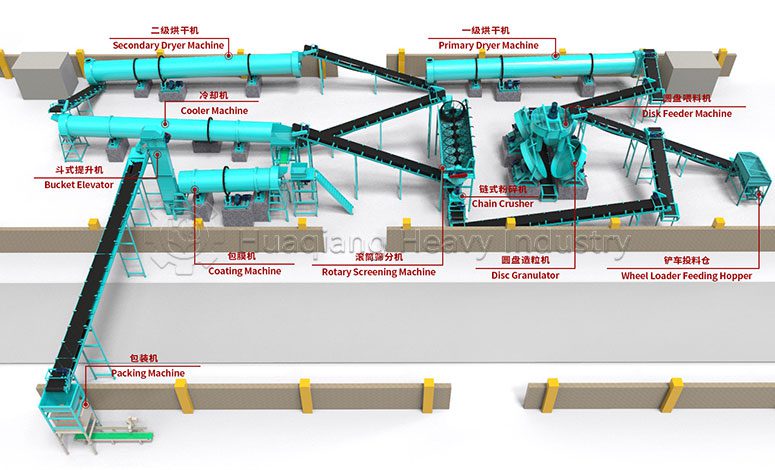
The NPK fertilizer production line is a dedicated production line named after the final product and is used to produce nitrogen, phosphorus and potassium ternary compound fertilizer. The raw materials are mainly inorganic fertilizers, including urea, monoammonium phosphate, potassium chloride, potassium sulfate, etc. Its core granulation equipment can choose disc granulator, rotary drum granulator or fertilizer compaction machine, depending on the formula and production capacity. The entire line is more complete, covering automatic batching, crushing and mixing, granulation and molding, drying and cooling, screening and return, coating and automatic packaging.
The main difference between the two production lines is the composition of raw materials and product positioning. The raw materials of the organic fertilizer production line are mainly organic waste, focusing on improving soil and increasing organic matter; the raw materials of the NPK production line are mainly chemical fertilizers, focusing on providing quick-acting nutrients. In terms of process flow, organic fertilizer production has stricter control over drying temperature to prevent burning of organic matter; NPK production pays more attention to ingredient accuracy and particle strength.
Generally speaking, the disc granulation line serves organic fertilizers, and the NPK line focuses on chemical compound fertilizers. When choosing, companies should make judgments based on the source of raw materials and target markets.