
(FAQ)What are the requirements for a urea fertilizer production line?
Urea is a mainstream fast-acting nitrogen fertilizer, characterized by its hygroscopic, melting, and caking properties. Therefore, it places specific and stringent requirements on the production line’s environment, equipment, processes, and safety control. A qualified urea fertilizer production line must not only meet basic production needs but also be adapted to the material’s characteristics to stably produce high-quality, compliant agricultural urea fertilizer.
Firstly, there are environmental requirements. Given urea’s strong hygroscopicity, the production line must utilize a closed workshop with strict temperature and humidity control to prevent the raw material from becoming damp, deteriorating, and caking. A fully enclosed transportation, proportioning, and processing system minimizes material contact with air, effectively preventing dust pollution, reducing raw material loss, and ensuring continuous and stable production.
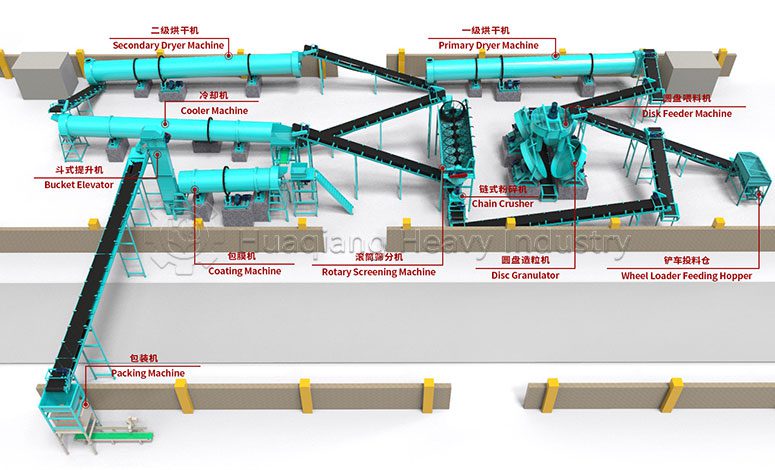
Secondly, there are process and equipment compatibility requirements. Urea is prone to decomposition and nutrient loss at high temperatures; therefore, the production line must employ low-temperature molding and low-temperature drying processes. It should also be equipped with a precise metering and batching system to flexibly adjust the production formula and ensure uniform nutrient content across batches. The molding equipment must be adapted to the characteristics of urea to ensure that the finished product has uniform granules and moderate hardness, reducing the generation of broken particles and powder.
Furthermore, there are requirements for finished product quality control. The urea fertilizer production line needs to be equipped with screening, dust removal, and cooling equipment to remove substandard particles, lower the finished product temperature, and prevent clumping during storage.
Finally, there are safety and maintenance requirements. Urea dust poses a safety hazard, so the production line needs to be equipped with comprehensive dust removal and explosion-proof facilities. The equipment structure needs to be simple and easy to clean to reduce material residue and mold growth, and be suitable for large-scale continuous production.