
NPK fertilizer production: An analysis of processes and technical routes
The production of NPK compound fertilizer is a process that precisely combines three key nutrients: nitrogen (N), phosphorus (P), and potassium (K). The industry currently employs several primary technical routes.
The slurry method uses phosphoric acid and ammonia as raw materials to generate a slurry through neutralization, followed by the addition of nitrogen and potassium elements for coating and granulation. While this method yields high-strength, high-quality products, it requires an integrated phosphoric acid plant, entailing significant investment. The solid agglomeration method involves pulverizing solid fertilizers—such as urea, ammonium phosphate, and potassium chloride—and then agglomerating them into granules within a rotary drum or disc(pan) granulator through humidification and heating. This method utilizes a wide range of raw materials, requires low investment, and allows for rapid project implementation, making it the most common process for small- and medium-sized compound fertilizer plants. The tower granulation method involves preparing a high-temperature fertilizer slurry and spraying it from the top of a tower; the droplets cool and solidify naturally as they fall, resulting in granules with uniform size and a smooth appearance.
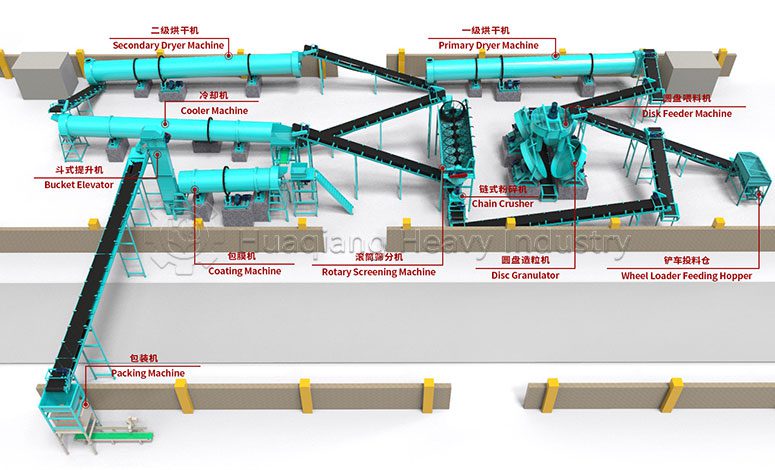
Regardless of the specific technical route, the NPK fertilizer production process comprises several core stages.
Batching and pulverization serve as the foundation for quality; raw materials are accurately weighed according to the formula and pulverized to the required fineness to ensure uniformity in subsequent mixing and granulation. Granulation is the core process: rotary drum granulation offers high capacity and excellent granule sphericity, making it suitable for large-scale continuous production; pan granulation features a simple structure and lower investment costs, making it ideal for small- to medium-scale operations; and twin-roll extrusion is a dry forming method that eliminates the need for drying. Drying and cooling are critical for storage stability; granules produced via wet methods must be dried to remove moisture and then cooled to room temperature to prevent caking. Screening and packaging constitute the final stage; granules meeting specifications undergo screening and anti-caking treatment before being packaged and warehoused.
NPK fertilizer production technology integrates various techniques from chemical engineering and mechanical processing. From the slurry method and agglomeration method to tower granulation, these diverse routes cater to a wide range of needs, spanning from large-scale industrial production to flexible, small- to medium-scale processing.