
What core technologies are required for an NPK blending fertilizer production line?
While an NPK blending fertilizer production line may appear to simply mix several types of granular fertilizers, ensuring nutrient uniformity and consistent quality requires the coordinated support of multiple core technologies.
High-precision automatic batching technology. This is the first step in ensuring nutrient accuracy. The system employs electronic weighing and PLC control to automatically measure raw materials—such as urea, ammonium phosphate, and potash—according to the formula, typically requiring an accuracy of within ±0.2%. Inaccurate batching cannot be remedied by subsequent mixing, regardless of how uniform the blend becomes.
High-efficiency, uniform mixing technology. Blended fertilizer production involves dry physical mixing, with the specialized bulk blending fertilizer machine serving as the core equipment. The key technology lies in achieving uniform distribution of materials with varying specific gravities and particle sizes within a short timeframe, while minimizing particle breakage; the coefficient of variation for mixing uniformity generally needs to be within 5%.
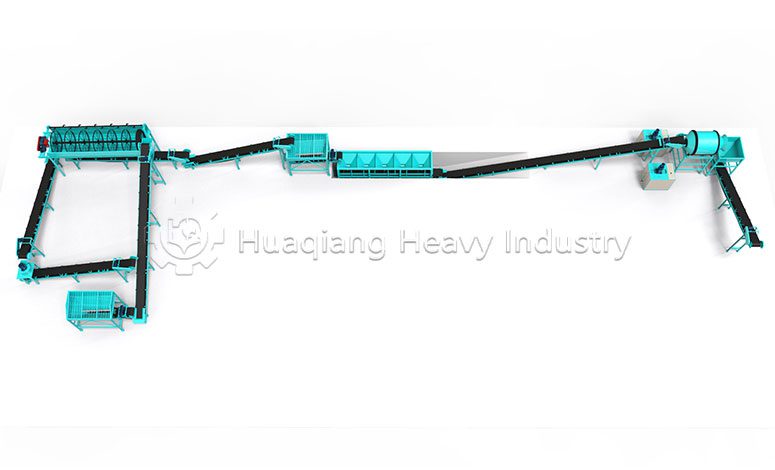
Segregation prevention and particle protection technology. There is a risk of segregation at every stage, from mixing to packaging, transport, and application. The production line must incorporate anti-segregation designs—such as flow diverters and anti-stratification chutes—at points like the blender discharge outlet, elevators, and packaging hoppers. Simultaneously, fertilizer mixer machine speeds and mixing elements must be optimized to prevent particle attrition and pulverization caused by friction.
PLC automation control technology. The entire line is coordinated by a PLC system that synchronizes the timing of batching, mixing, and packaging. It features formula storage and rapid switching capabilities, enabling flexible production of various NPK formulations.
Environmental dust control technology. The blending process generates dust, necessitating the installation of bag-type or pulse-jet dust collection systems to ensure workshop dust levels meet standards while recovering materials and reducing waste.
Only through the synergy of these technologies can stable production line operation and consistent product quality be guaranteed. When setting up a facility, enterprises should prioritize three core aspects: batching accuracy, mixing uniformity, and anti-segregation design.