
Commercial production of organic fertilizers: From production capacity to market realization
The core of commercial organic fertilizer production lies in balancing three key elements: “large-scale production, stable quality, and compliant adaptation.” Unlike small-scale workshop production, it requires considering production efficiency, product competitiveness, and market demand to achieve a closed-loop operation from raw material processing to terminal sales.
Precise market positioning is the prerequisite. It requires combining regional planting structures, focusing on economic crops such as fruits, vegetables, and tea, or field crops, and customizing formulas with high organic matter and targeted addition of trace elements. Simultaneously, differentiating between high-end organic fertilizers and general-purpose products is necessary to match the purchasing power and needs of different customer groups.
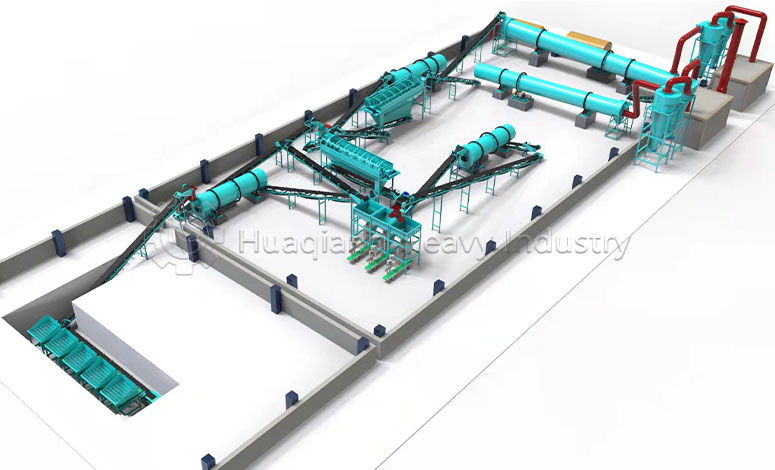
Standardized mass production is the core support. Establishing a complete organic fertilizer production line, using fertilizer mixers for uniform raw material mixing, relying on fermentation equipment to complete the composting process, and utilizing organic fertilizer granulation equipment to improve product appearance, can be linked with NPK fertilizer production lines to expand the range of compound organic fertilizers, balancing production capacity and product diversity.
Quality compliance is fundamental. Strictly adhering to national organic fertilizer standards, controlling raw material safety and maturity, regularly testing indicators such as organic matter and effective viable bacteria count, standardizing product labeling, and obtaining relevant production and organic certifications are crucial to mitigate compliance risks.
Channel layout and cost control determine profitability. Connecting with distributors, planting bases, and agricultural supply stores expands offline channels, while also leveraging online e-commerce for traffic; optimizing raw material procurement and production processes reduces energy consumption and operating costs, enabling large-scale profitability.