
(FAQ)Is the roller press granulator production line widely applicable?
Among fertilizer granulation equipment, the fertilizer compaction machine, with its unique dry-process, physical extrusion molding technology, has become a highly versatile molding device. Overall, this production line has a wide range of applications, suitable for the production of multiple types of fertilizers and diverse production scales. However, it also has clear application boundaries and is not universally applicable to all materials.
From a material compatibility perspective, the roller press granulator production line covers the vast majority of inorganic fertilizer raw materials. Whether it’s single nitrogen, potassium, or phosphate fertilizer powders such as urea, ammonium sulfate, potassium chloride, and monoammonium phosphate, or NPK compound powders of any proportion, they can all be directly dry-extruded. It is also compatible with modified fertilizer materials containing added micronutrients and conditioners, without changing the raw material formula or adding water or binders, offering extremely high material adaptability.
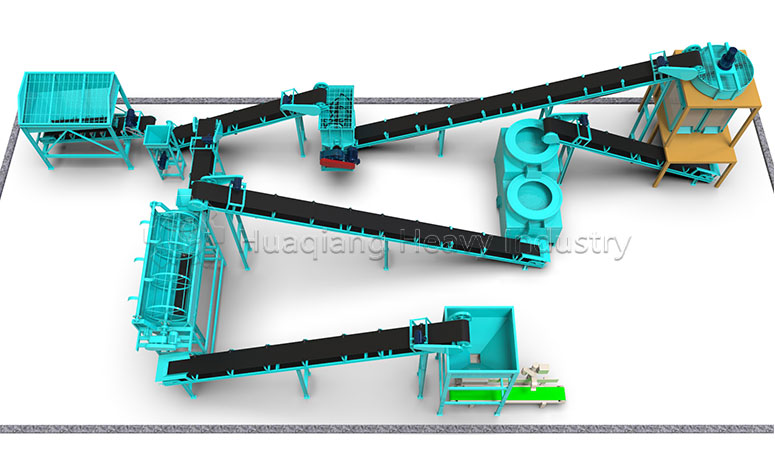
In terms of production scenarios, this production line’s adaptability is equally outstanding. The entire equipment process is concise, requiring no complex supporting processes such as drying and cooling. It is suitable for both small-batch, multi-formulation customized fertilizer production and standardized, large-scale routine production. Of course, roller press granulator production lines are not omnipotent and have certain limitations. They are unsuitable for pure organic materials with high fiber content and high moisture content, as these materials have poor plasticity and are prone to springback, leading to a significant decrease in the forming rate. Furthermore, the equipment produces irregularly shaped granules, making it less suitable for high-end products requiring extremely high roundness in fertilizer appearance.
In summary, roller press granulator production lines have a very wide range of applications in the fields of inorganic compound fertilizers and mineral fertilizers, with versatility far exceeding most granulation equipment. Their only weakness lies in the production of high-fiber organic materials and high-end rounded granules; overall, they are suitable for the vast majority of conventional fertilizer production needs.