
Can a double axis paddle mixer be used for the fermentation and crushing of organic waste?
Many organic fertilizer producers often wonder: Can a double axis paddle mixer be utilized in the process of fermenting and crushing organic waste? The answer is a resounding yes; in fact, it represents a highly cost-effective choice for the treatment of organic waste on a small to medium scale. This machine effectively handles both the mixing requirements of the fermentation stage and the light crushing needed during the size-reduction stage, making it suitable for processing a wide variety of organic waste materials.
During the fermentation stage, the double axis paddle mixer employs counter-rotating paddles to thoroughly blend raw materials—such as livestock and poultry manure, as well as crop straw. This ensures intimate contact between the microorganisms and the substrate, thereby accelerating high-temperature composting. Simultaneously, it breaks down large clumps of raw material, preventing issues related to uneven or incomplete fermentation in specific areas.
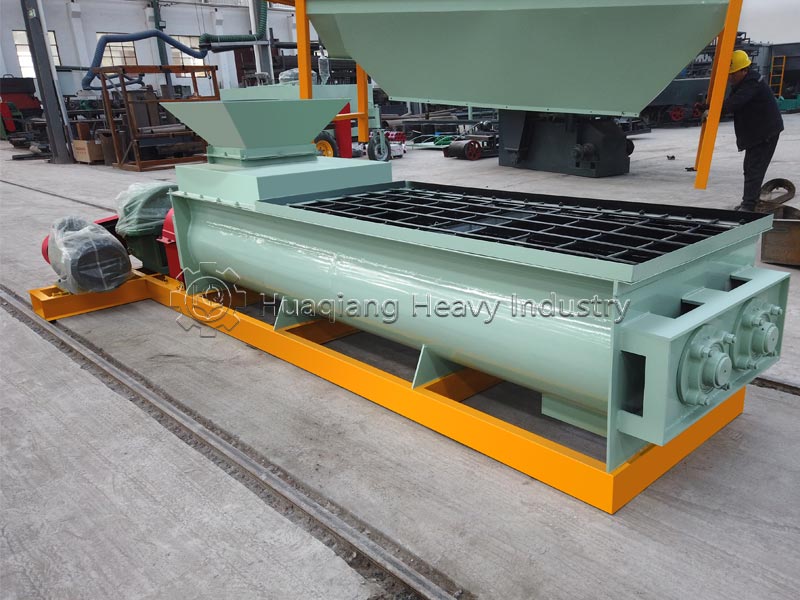
During the crushing stage—although not classified as specialized crushing machinery—the mixer leverages the shearing and squeezing actions of its paddles to break down the agglomerated material resulting from fermentation into a uniform, loose state. This eliminates the need for additional specialized crushing equipment, thereby saving on capital investment and floor space while satisfying the material feed requirements for subsequent processing steps.
Practical Considerations: For harder waste materials—such as coarse straw—a simple pre-treatment step is recommended prior to processing. Additionally, by adjusting the paddle rotation speed, the machine can be optimized to meet the specific requirements for either fermentation mixing or light crushing. In summary, by balancing both practicality and economic efficiency, the double axis paddle mixer stands as an ideal auxiliary equipment choice for small to medium-scale organic fertilizer production lines.