
Why are double roller press granulators only suitable for compound fertilizer production?
Among fertilizer granulation equipment, double roller press granulators have a clear application boundary—they are only suitable for the production of compound fertilizers (including NPK compound fertilizers and organic-inorganic compound fertilizers), and cannot be used for single-category fertilizers such as pure organic fertilizers, pure urea, and pure potassium fertilizers.
The key limitation lies in its core process: double roller press granulators use dry granulation, requiring no water addition or drying. They rely on high-pressure extrusion to shape the raw materials, requiring the raw materials to possess certain binding properties, uniform particle size, and be resistant to moisture absorption and decomposition—precisely the core characteristics of compound fertilizers.
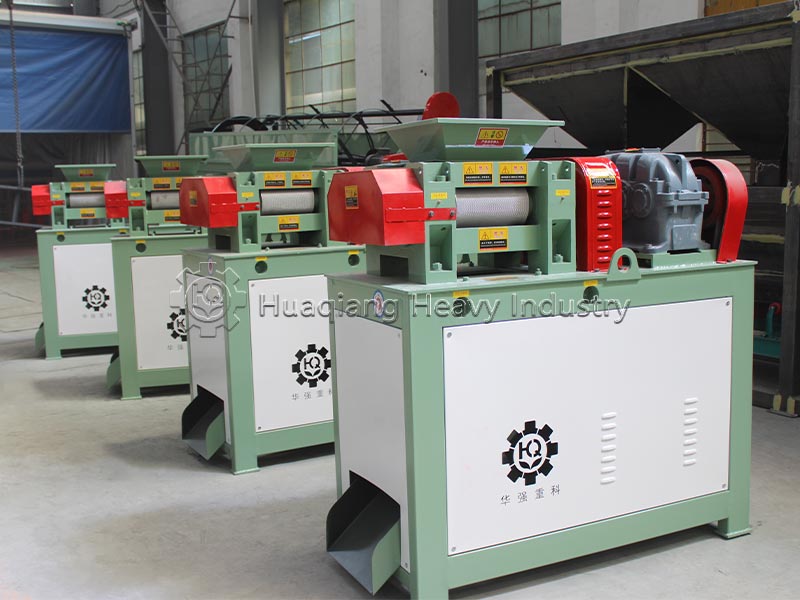
Compound fertilizers are composed of a mixture of various raw materials. The combination of nitrogen, phosphorus, potassium, and auxiliary materials creates a natural binding agent, allowing for rapid shaping under high pressure, and achieving the required granule strength without the need for additional binders. Single fertilizers, however, cannot meet this requirement: pure organic fertilizer raw materials are loose and have poor binding properties, easily crumbling after extrusion; pure urea and potassium fertilizers are highly hygroscopic, easily clumping and sticking to the pressure rollers after extrusion, failing to form qualified granules.
Furthermore, the capacity and forming effect of the double roller press granulator are highly compatible with the needs of compound fertilizer production. Single fertilizer production often requires large-scale, high-quality production, but roller extrusion produces irregular granules with limited capacity, failing to meet these demands.
In summary, the dry extrusion process of the double roller press granulator limits its application to compound fertilizer production, which involves mixing multiple raw materials and possesses binding properties. Therefore, its application is strictly confined to the compound fertilizer sector.