
Is a flat die pelleting machine suitable for a bio-organic fertilizer production line?
Many organic fertilizer manufacturers struggle with whether flat die pelleting machines are suitable for bio-organic fertilizer production lines when selecting equipment. In fact, this equipment is very suitable for small and medium-sized bio-organic fertilizer and functional bio-fertilizer production lines, thanks to its specialized extrusion process that perfectly meets the needs of bio-fertilizer production. However, it also has certain limitations.
The core advantage of the flat die pelleting machine is its room-temperature dry extrusion molding, perfectly suited to the characteristics of bio-organic fertilizers. Bio-organic fertilizers contain active beneficial bacteria, which are easily inactivated by high temperatures. This equipment operates at low temperatures throughout the process, preserving the activity of the bacteria and effectively maintaining the biological efficacy of the fertilizer—an advantage that wet granulation equipment lacks.
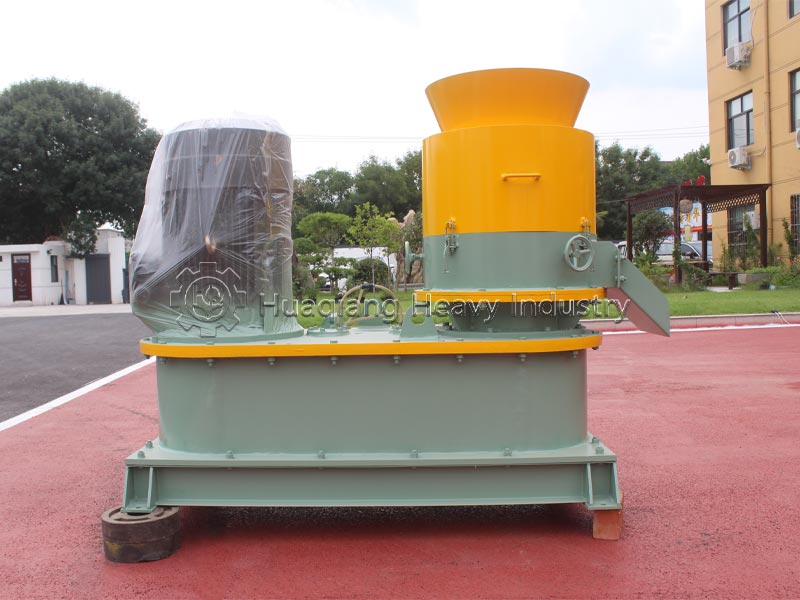
Furthermore, the equipment produces high-quality finished products. The processed granules are compact and hard, less prone to powdering and breakage, and more durable for storage and long-distance transportation, reducing product loss. Moreover, the equipment has a simple structure, low failure rate, and low maintenance costs. It requires no complex supporting facilities, has a low entry barrier, and is suitable for the regular and stable production of small and medium-sized factories.
This equipment also has significant limitations. It has high requirements for raw material standards, requiring fully decomposed, uniformly pulverized raw materials with suitable moisture content. High-moisture, high-impurity raw materials are prone to causing mold blockage and poor molding. Furthermore, the equipment’s capacity is limited and cannot meet the needs of large-scale production exceeding 100 tons per day.
In summary, the flat die pelleting machine is a cost-effective piece of equipment for small and medium-sized bio-organic fertilizer production lines, balancing production quality and cost. For large-scale production projects, it can be used in conjunction with auxiliary equipment to meet the demands of large-scale production.