
Fertilizer roller granulator: A cost-effective and efficient solution for dry compaction
In fertilizer production, the granulation process directly impacts product quality. Traditional wet granulation requires multiple steps, including water addition, drying, and crushing, resulting in high energy consumption and significant investment. In recent years, however, the fertilizer roller granulator, with its unique advantages in dry compaction, has become the choice of an increasing number of manufacturers. Its core principle is to use a fertilizer compactor to forcibly compress powdery materials into thin sheets, which are then crushed and screened to obtain uniform granules. This process is called fertilizer granules compaction.
Compared to wet processes, roller granulation eliminates the need for liquid binders and hot air drying, thus saving significant amounts of fuel or electricity and avoiding nutrient loss caused by drying. For heat-sensitive materials, dry compaction operates at room temperature throughout, preserving the active ingredients.
A typical roller granulator’s core components are two opposing rotating pressure rollers. The roller surfaces can be designed with a spherical or recessed shape, directly determining the size of the finished granules. Material is forcibly fed between two rollers and compacted into dense flakes under several tons of pressure. After discharge, only low-power crushing and screening are needed to recover qualified granules. The entire line occupies only half the space of a wet process.
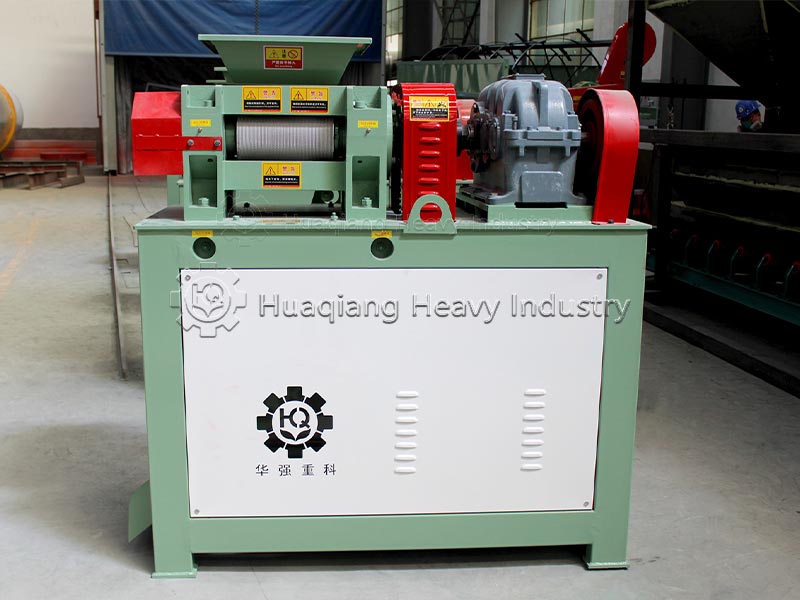
From an equipment linkage perspective, the fertilizer compactor is the most critical execution unit. The compaction effect depends on the roller material, pressure, and material particle size. If the fine powder is insufficient or too dry, it is difficult to form, usually requiring pretreatment or slight humidification. However, overall, the yield of fertilizer granules compaction can reach over 80%, with undersized fine powder directly returned to the recycling system, resulting in almost no waste.
In terms of economics, using roller granulation instead of traditional wet processes can reduce equipment investment by 30%-40%, reduce operating energy consumption by over 50%, and eliminate the need for heavy equipment such as hot air furnaces and dryers, significantly reducing maintenance costs. This technology is particularly attractive for small to medium-sized fertilizer plants with an annual production capacity of 10,000-30,000 tons. Granules produced by compaction have high strength, are not easily pulverized, and exhibit excellent storage and transportation performance.
Of course, dry compaction also has its limitations. It is more suitable for products that are sensitive to moisture and require high-concentration formulations, such as potassium sulfate, compound fertilizers, and potassium chloride. Overall, fertilizer roller granulators, compactors, and granulation technology together constitute a highly efficient, clean, and economical granulation solution.