
Technical details in NPK production lines: From batching precision to granulation control
The ability of an NPK fertilizer production line to consistently yield high-quality products depends on the precise control of process parameters. Configuring such a line is not merely a matter of assembling equipment; it is a systems engineering process centered on the core requirements of NPK fertilizer production technology.
Batching precision is the lifeline of quality for the entire line. The nutrient content of NPK compound fertilizer is directly determined by the formula, and any weighing error for a specific raw material will be reflected in deviations in the final product. Utilizing a loss-in-weight automatic batching system—which offers precision of up to ±0.2%—effectively ensures batch-to-batch consistency. If batching precision is inadequate or calibration is not performed in a timely manner, the product will struggle to meet standards, regardless of how refined the subsequent granulation process may be.
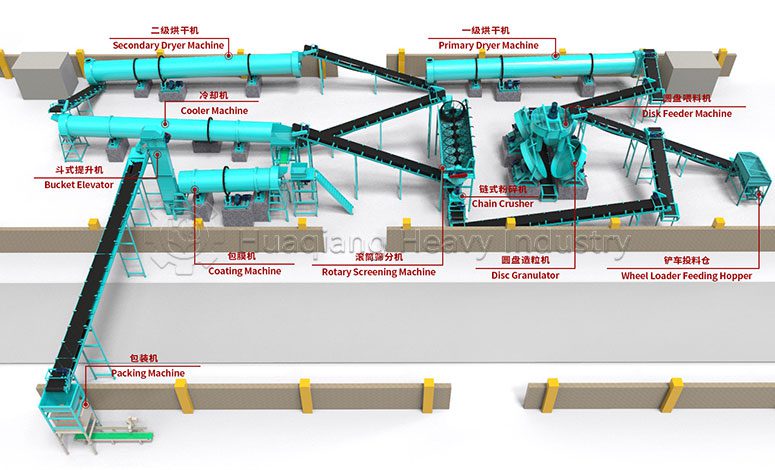
Parameter control during the granulation stage is equally critical. Taking drum granulation as an example, factors such as steam pressure, water spray flow rate, drum rotation speed, and drum inclination collectively determine the granulation rate and particle size distribution. Excessive pressure leads to oversized granules, while insufficient pressure results in an increase in fine powder. Operators must adjust parameters based on the real-time state of the material, complementing the automated control systems.
Technical handling of screening and material recycling cannot be overlooked. After granulation, the material undergoes screening; qualified granules proceed to packaging, while undersized and oversized particles are returned to the granulation section via a recycling system. Fluctuations in the recycle load directly impact the material balance within the granulator; consequently, high-quality NPK fertilizer lines typically incorporate recycle buffer bins and flow regulation devices.
From the perspective of the entire NPK fertilizer production line, long-term stable operation is achievable only when the three key technical aspects—batching precision, granulation parameters, and recycle control—are effectively implemented. When selecting technology, complexity is not the goal; rather, the priority is finding a solution that best aligns with the specific raw materials and product positioning.