
Selecting a mixer for NPK fertilizer production lines: General-purpose vs. Specialized equipment
In an NPK fertilizer production line, the mixing stage—while just one of many processes—directly impacts the quality of the final product. Understanding the specific applications of different mixers is essential for making the right choice.
In NPK compound fertilizer production, mixing takes place prior to granulation. Raw materials are in powder form and require high-intensity mixing to thoroughly blend nitrogen, phosphorus, potassium, fillers, and trace elements, thereby creating a uniform feedstock for the subsequent granulation process. Consequently, the requirements for an NPK production line mixer are “high power, speed, and uniformity” rather than “gentle handling or material protection.”
The double axis paddle mixer is designed specifically to meet these needs. Paddles mounted on two horizontal shafts rotate in opposite directions at the same speed, propelling the material to move axially, radially, and circumferentially. At high linear speeds, the material is thrown upward into a weightless state, achieving thorough mixing as it falls back down; a single batch takes only 30 to 120 seconds to process. These mixers exert strong shear forces, which also serve to break up any agglomerated material.
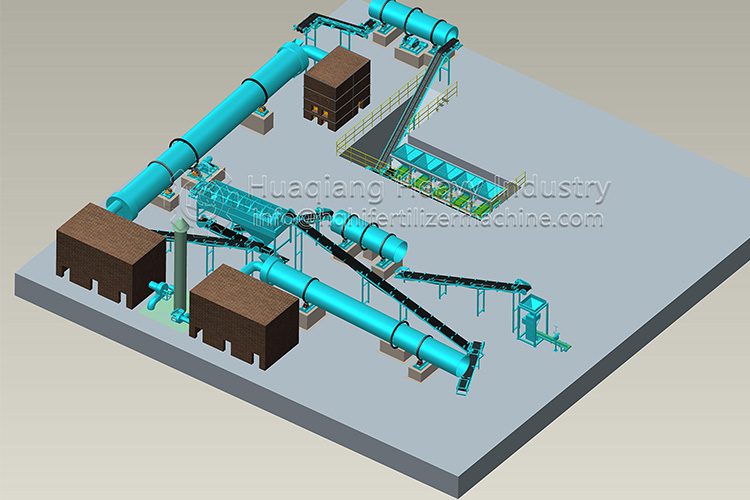
Within the context of the entire NPK production line, the mixer is positioned after the automatic batching system and before the granulator. Its batch processing capacity must align with the throughput of the preceding and succeeding stages. Fertilizer mixer machine specifications and power ratings should be determined based on the required hourly output and the complexity of the formulation.
In summary, NPK fertilizer production demands powerful and efficient mixing; thanks to its ability to deliver rapid, uniform blending and strong shear forces, the double-axis paddle mixer has become the mainstream choice for NPK powder pre-mixing.