
NPK compound fertilizer granulation: Rotary drum vs. Disc pan—Which to choose?
Granulation is the core stage in NPK compound fertilizer production, directly determining granule strength, nutrient uniformity, and the overall efficiency of the production line. Currently, the two most common types of granulation equipment in the industry are rotary drum granulators and pan (disc) granulators. While both utilize agglomeration-based processes, they differ significantly in terms of applicable scale, investment costs, and product positioning.
The rotary drum granulator is the preferred choice for large-scale NPK compound fertilizer production lines. The main body consists of a horizontally mounted rotating cylinder; as material enters, it tumbles and collides with the rotation of the cylinder, agglomerating into spheres under the influence of steam or water mist. A single unit can achieve an hourly output of 10 to 20 tons, with a granulation rate typically ranging from 70% to 95%. Drum granulation is capable of producing high, medium, and low-concentration NPK products—being particularly well-suited for high-nitrogen formulations (N ≥ 20%)—and offers strong process stability. Its drawbacks include higher equipment investment, a large footprint, and the need for auxiliary systems such as drying, cooling, and screening units.
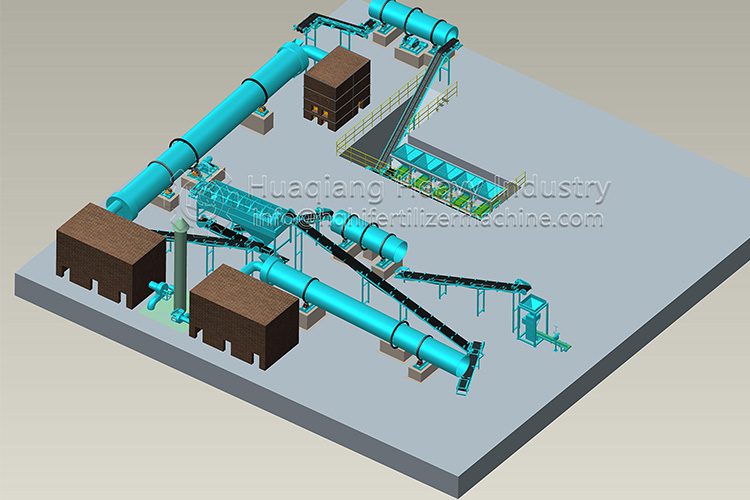
In contrast, the pan granulator is known for its simple structure and low investment cost. The equipment consists of an inclined rotating pan; material rolls within the pan as it rotates, naturally forming spheres after water is sprayed onto it. Its advantages lie in intuitive operation, flexibility in switching formulations, and rapid project implementation. However, due to structural limitations, pan granulation is generally suitable only for medium- and low-concentration NPK products; single-unit output is lower, and stability in large-scale continuous production is not as high as that of the drum process.
Overall, each process has its own distinct application scenarios. For large-scale compound fertilizer projects with an annual output exceeding 50,000 tons, the rotary drum granulator is the superior choice; meanwhile, the pan granulator retains a significant market position for small-to-medium-scale production and the processing of diverse, small-batch specialty fertilizers, thanks to its flexibility and low cost. When selecting equipment, enterprises should make the most appropriate decision by comprehensively weighing their production capacity plans, product positioning, and investment budgets.