
Differences between disc granulators and flat die pelleting machines for processing chicken manure fertilizer
After undergoing fermentation, decomposition, and appropriate treatment, chicken manure can be processed into organic fertilizer granules using various types of fertilizer granulators. Disc granulators and flat die pelleting machines are two common options; they differ significantly in terms of granule appearance, density, and production process.
1.Differences in Granule Shape
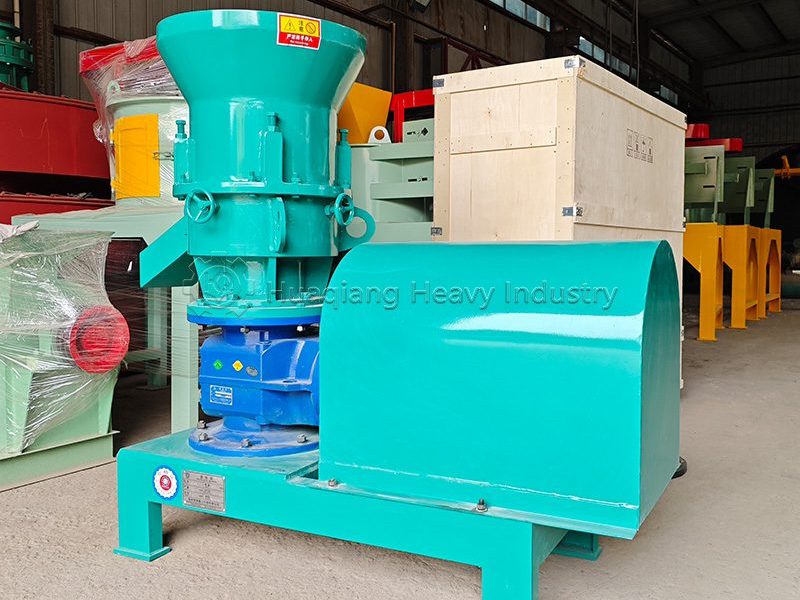
Disc granulators rely on the rotation of a disc to cause the material to roll and bind together, resulting in chicken manure fertilizer granules that are typically spherical with a relatively smooth surface. The size of these granules can be controlled by adjusting equipment parameters. In contrast, flat die pelleting machines use pressure rollers to force the material through holes in a die, producing granules that are generally cylindrical in shape.
2.Differences in Granule Density
Disc granulation relies primarily on the rolling and binding of materials, which results in a relatively loose internal structure. Flat-die granulation employs mechanical extrusion, producing granules that are more compact, with higher density and greater hardness.
3.Differences in Raw Material Processing Requirements
Disc granulators require careful control of the moisture content and adhesiveness of the chicken manure to ensure successful granule formation. Flat die pelleting machines have specific requirements regarding the fineness of the pulverized raw material and its moisture content; maintaining the material in an optimal state helps prevent the die holes from clogging and improves the quality of the formed granules.
4.How to Choose the Right Equipment?
If the priority is achieving round, uniform granules, a disc granulator is a suitable choice. If the focus is on granule compactness and the results of extrusion-based forming, a flat die pelleting machine should be considered.
Overall, both types of equipment offer distinct advantages for processing chicken manure fertilizer. The final choice should be based on factors such as the characteristics of the raw material, the required specifications of the finished product, production volume, and subsequent requirements for packaging and transportation.