
Comparison of organic-inorganic compound fertilizers and NPK blended fertilizers
Organic-inorganic compound fertilizers and NPK blended fertilizers are both common types of fertilizers, yet they differ significantly in terms of raw material composition, production processes, and application effects.
Differences in raw material composition: Organic-inorganic compound fertilizers contain both decomposed organic materials (such as livestock and poultry manure, straw powder, or humic acid) and inorganic chemical fertilizers, integrating organic matter and inorganic nutrients into a single product. In contrast, NPK blended fertilizers are composed of granular inorganic fertilizers mixed physically according to a specific formula; they typically contain little to no organic matter.
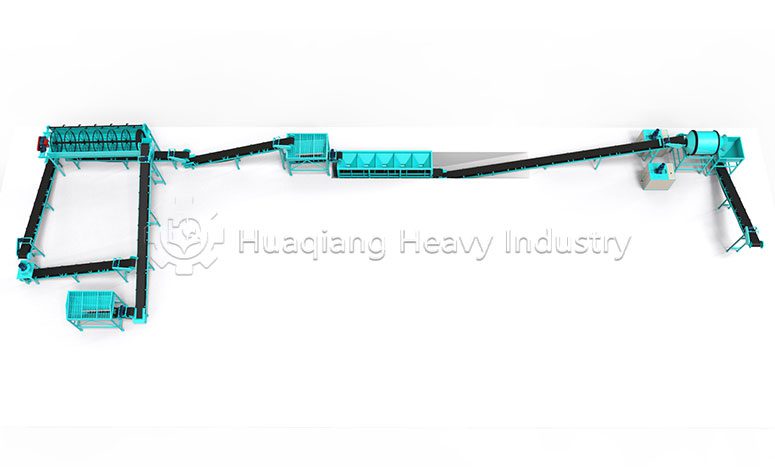
Differences in production processes: Organic-inorganic compound fertilizers require a granulation stage, where organic materials and inorganic fertilizers are combined into granules using equipment such as disc granulators or rotary drum granulators. This process is relatively complex and demands strict control over moisture content and mixing uniformity. NPK blended fertilizers are produced through a purely physical mixing process on an NPK blending fertilizer production line; since the raw materials are already in the form of finished granules, steps such as granulation, drying, and cooling are eliminated.
Differences in nutrient release characteristics: The organic matter in organic-inorganic compound fertilizers provides a slow-release effect, ensuring a steady supply of nutrients while improving soil structure and enhancing the soil’s water and nutrient retention capacity. NPK blended fertilizers release nutrients more rapidly, making them well-suited for top-dressing during critical periods of crop nutrient demand; however, long-term exclusive use offers limited benefits for increasing soil organic matter.
Differences in application scenarios: Organic-inorganic compound fertilizers are better suited for situations where soil improvement and long-lasting nutrient availability are prioritized, such as in orchards, vegetable cultivation, or the restoration of degraded soil. NPK blended fertilizers are ideal for large-scale field crops and precision fertilization, particularly when rapid nutrient replenishment is required or when soil conditions vary significantly across a region.
Differences in cost and market positioning: Due to the inclusion of organic matter and the requirement for a granulation process, organic-inorganic compound fertilizers generally have higher production costs and are typically positioned for the mid-to-high-end market or for specialized crops. NPK blended fertilizers, with their lower production costs and flexible formulations, offer a greater price advantage in the bulk fertilizer market.
Overall, the two types of fertilizers are not mutually exclusive alternatives. Organic-inorganic compound fertilizers focus on “improving the soil and supplying nutrients,” while NPK blended fertilizers emphasize “precision and high efficiency.”