
How effective is a double roller press granulator for processing organic-inorganic compound fertilizers?
Organic-inorganic compound fertilizers contain both organic materials and inorganic chemical fertilizers, which often complicates the granulation process. Methods like disc or drum granulation require drying, but high temperatures can lead to the loss of organic matter. Conversely, dry-type extrusion granulation raises concerns regarding the high stickiness of organic materials and the resulting instability in granule formation. Whether a double roller press granulator is suitable depends entirely on whether the process conditions are properly aligned.
In terms of operating principle, a fertilizer compaction machine is well-suited for this type of product. It uses high pressure from two counter-rotating rollers to force powdered materials into sheets or strips, which are subsequently crushed and screened into granules. This process requires no added water and no drying. Organic matter and chemical fertilizers are bonded together under high pressure; since the process does not rely on the material’s inherent stickiness to form spheres, it effectively bypasses the common difficulty of granulating organic materials. Furthermore, because the material is shaped at ambient temperature, the organic matter—as well as any functional microorganisms—remains undamaged by heat.
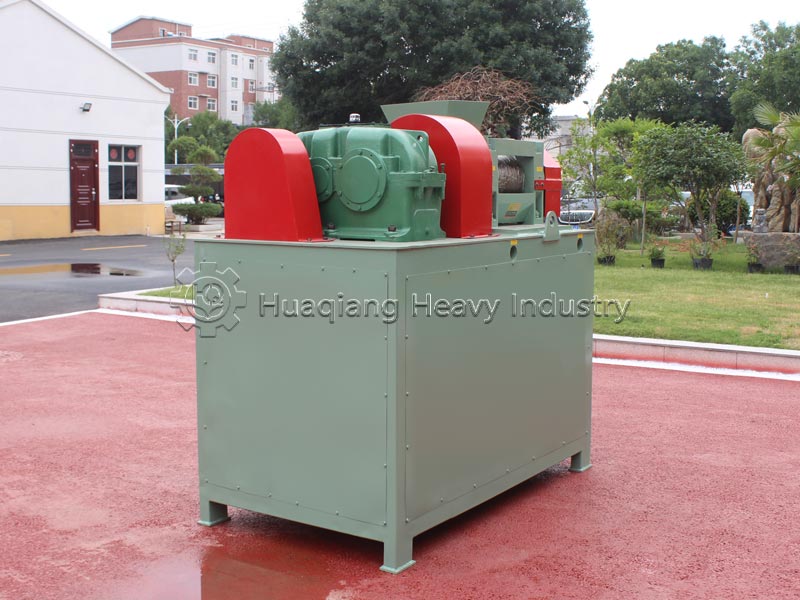
However, the state of the raw materials must be carefully controlled prior to processing. Moisture content is the primary factor; after mixing, the moisture level should generally be kept below 8%. If it is too high, the material may stick to the rollers or cause slippage; if it is too low, the resulting granules may be loose or crumbly. Organic materials should be pulverized to a fineness of 20–40 mesh before entering the machine, as excessively long fibers can wrap around the roller surfaces or cause blockages. Precise formulation is also essential—organic and inorganic components must be thoroughly mixed to prevent localized concentrations of organic matter, which could destabilize the extrusion process.
There are also practical considerations to keep in mind. When the proportion of organic material is high, the material’s flowability decreases, which can lead to fluctuations in the feed supply; therefore, the output rate of the mixer must be synchronized with the throughput of the fertilizer granules compaction machine. Roller surfaces will also experience faster wear compared to processing purely inorganic formulas, necessitating regular inspections of the roller gaps and surface conditions. Additionally, the final granules tend to be more cylindrical or flake-like in appearance—lacking the roundness achieved through drum granulation—which is a factor to weigh if the product’s visual appeal is a priority.
Overall, using a double roller press granulator for organic-inorganic compound fertilizers is a viable approach. It is particularly well-suited for small-to-medium-scale production environments where drying facilities are unavailable and the preservation of organic matter is a key objective. The key lies in effectively controlling moisture content, particle fineness, and the mix ratio, so as to fully leverage the advantages of the fertilizer granules compaction process.