
Key considerations for coordinating half-wet material crushers and flat die pelleting machines
In organic fertilizer production, the combination of a half-wet material crusher and a flat die pelleting machine is common. The former processes high-moisture raw materials into a state suitable for granulation, while the latter performs dry extrusion molding. The effectiveness of their coordination directly impacts the granulation rate and granule quality.
Half-wet material crushers are designed for materials with high moisture content, such as decomposed livestock manure, biogas residue, distillers’ grains, and spent mushroom substrate. These materials are often sticky and prone to causing blockages, making them difficult for standard crushers to handle. Half-wet crushers utilize specialized blades and anti-stick designs to reduce material size to a range of 20 to 40 mesh. Particles that are too coarse hinder flat-die molding, while those that are too fine increase extrusion resistance.
Flat die pelleting machines employ ambient-temperature dry extrusion, forcing material between pressure rollers and the die to form cylindrical granules. Feed moisture is typically controlled between 20% and 30%; excessive moisture leads to slippage and clogging, while insufficient moisture results in loose granules. If the crushed material has uniform fineness and is free of large impurities, both the granulation rate and granule strength will improve significantly.
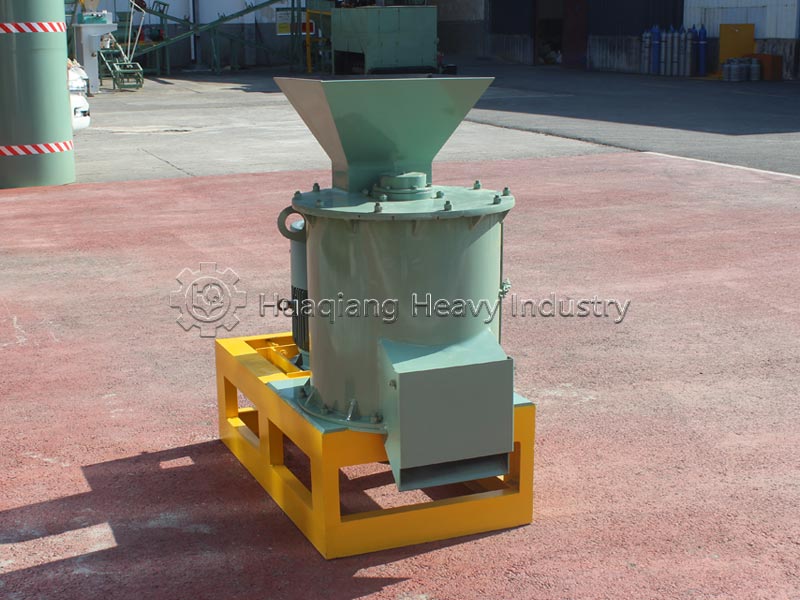
Production capacity matching is equally important. The throughput of the half-wet material crusher should slightly exceed the granulator’s requirements to ensure continuous feeding and avoid frequent start-stop cycles. Crushed material should ideally be fed directly into the granulator rather than being stockpiled for extended periods, which could lead to moisture loss or re-agglomeration.
Regarding maintenance, half-wet material crushers require regular checks for blade wear and screen clogging, whereas flat die pelleting machines require monitoring of die and pressure roller wear. Operators must adjust crushing fineness and granulation moisture levels based on material characteristics to ensure stable production line operation.
In summary, the proper coordination of semi-wet material crushers and flat die pelleting machines is a crucial aspect of organic fertilizer dry granulation production lines. Mastering these coordination points helps increase granulation rates, reduce material recycling, and enhance overall production efficiency.