
Key equipment configuration of disc granulation production line for organic fertilizer
Large-scale organic fertilizer commercial production requires complete and systematic processing equipment to ensure stable granulation quality and continuous output. A mature production system relies on coordinated operation of pretreatment and molding equipment. The disc granulation production line is a widely applied integrated production system for organic fertilizer processing, featuring stable operation, high finished product quality and strong production continuity.
The overall operation efficiency of the disc granulation production line depends heavily on raw material pretreatment effects. The double axis paddle mixer serves as the core pretreatment equipment of the entire line. It features dual-shaft staggered stirring design, which can fully mix fermented manure, crop straw powder and auxiliary materials evenly. Different from ordinary mixing equipment, it achieves no dead-angle stirring, effectively balancing material humidity and uniformity. Standardized mixing pretreatment lays a solid foundation for subsequent smooth granulation and reduces defective particle generation.
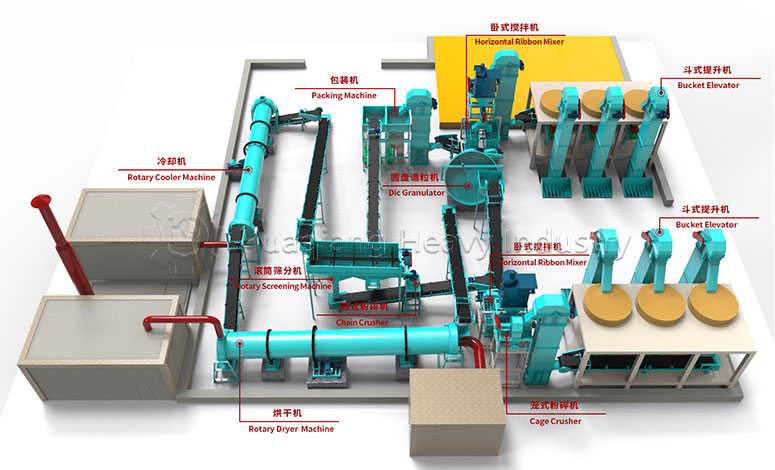
As the core molding unit of the whole system, the organic fertilizer granules machine undertakes the final particle forming work. Matched with the stable feeding of the mixing equipment, it adapts to the physical characteristics of diverse organic raw materials. Through continuous rolling and shaping inside the disc, it produces round and uniform organic fertilizer granules with high molding rate. The finished granules have proper density and good fluidity, suitable for mechanical sowing and long-term storage.
The perfect coordination of double axis paddle mixer and organic fertilizer granules machine endows the disc granulation production line with outstanding production advantages. The integrated process from uniform mixing to integral molding standardizes every production link. It effectively improves material utilization, stabilizes batch production quality, and avoids common problems such as uneven particle size and low granulation rate.
In agricultural fertilizer manufacturing, this fully matched production configuration meets the mass production demand of high-quality organic fertilizers. It provides a reliable and efficient systematic solution for modern standardized organic fertilizer processing.