
Which fertilizer granulator is best suited for nitrogen and potassium fertilizers respectively?
Nitrogen and potassium fertilizers are core raw materials for NPK compound fertilizers. Their physicochemical properties differ significantly, with variations in hygroscopicity, hardness, and binding properties, making them unsuitable for the same granulation equipment. Targeted selection based on material characteristics can effectively improve pelleting rate, reduce raw material loss, and solve common problems such as unstable finished product quality and poor granulation results in production lines.
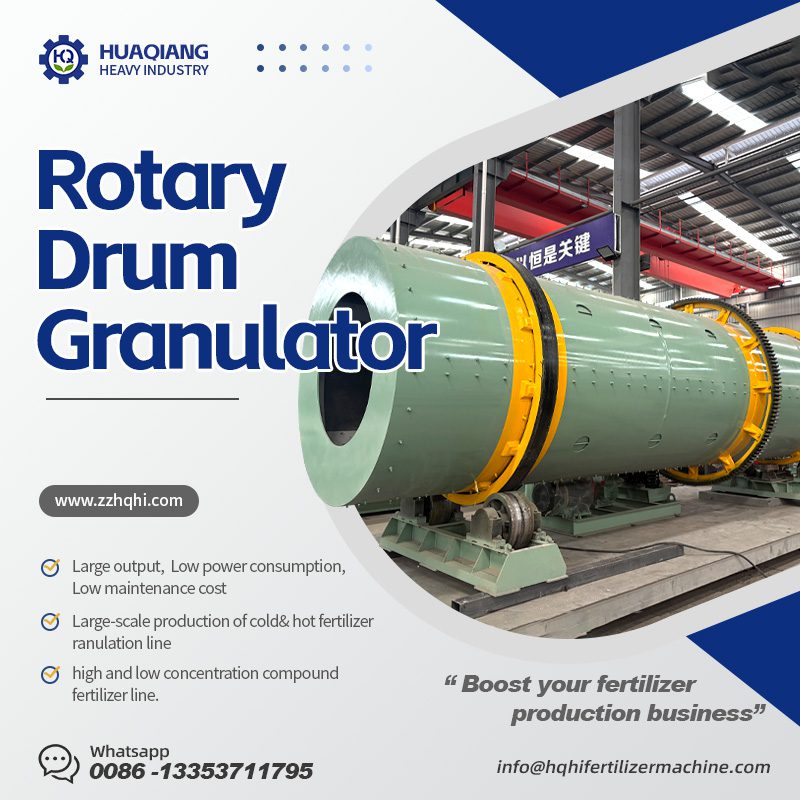
Nitrogen fertilizers are soft in texture, highly hygroscopic, and prone to decomposition and volatilization at high temperatures. They are best suited for wet granulation processes using rotary drum granulators. This equipment relies on a binder liquid for assisted molding and operates at low temperatures throughout, effectively preventing nitrogen nutrient loss. The material tumbles evenly, resulting in round and regular granules. It is suitable for nitrogen fertilizer raw materials such as urea and ammonium bicarbonate, and is ideal for large-scale continuous production of nitrogen-containing fertilizers.
Potassium fertilizers are mostly hard crystalline structures with extremely poor binding properties, making wet molding difficult. They are better suited for dry granulation modes using double roller press granulators. This process eliminates the need for water addition and drying, relying solely on physical extrusion for direct molding. It completely solves the problems of potassium fertilizer’s difficulty in pelletizing and its tendency to crumble, preventing raw materials from becoming damp and clumping. The finished product has high hardness and is resistant to storage and transportation, making it suitable for processing potassium chloride, potassium sulfate, and other potassium fertilizers.
For the production of nitrogen, phosphorus, and potassium multi-component compound fertilizers, a dedicated NPK fertilizer granulator machine can be selected. This equipment boasts strong compatibility, allowing for flexible adjustment of process parameters according to different formulations, adapting to the granulation needs of various fertilizer mixtures.
In summary, moisture- and volatile nitrogen fertilizers are suitable for rotary drum granulators, hard crystalline potassium fertilizers are suitable for double roller press granulators, and multi-component compound fertilizers are suitable for NPK fertilizer granulator machines. Selecting the appropriate granulator based on material characteristics is the core key to stable mass production, improved quality, and reduced consumption in fertilizer production lines.