
Compaction granulation: An underrated dry process in NPK production
Among the various granulation methods available for NPK fertilizer production lines, compaction granulation is often viewed as a “niche” option. However, this dry process—centered on the fertilizer compaction machine—is demonstrating irreplaceable value in specific scenarios thanks to its unique cost advantages and product characteristics.
The principle behind fertilizer granules compaction differs fundamentally from that of wet granulation. Compaction granulation relies purely on high-pressure physical force. Powdered raw materials are fed between two counter-rotating rollers, where they are squeezed into dense sheets under pressures of 10–30 MPa; these sheets are subsequently crushed and screened to produce the final granules.
The workflow of an extrusion-based NPK line is far simpler than that of a wet process: after automatic proportioning and uniform mixing, the material is fed into the fertilizer compaction machine by a forced-feeding device, pressed into sheets by rollers, and then crushed, granulated, and screened. On-spec granules proceed to packaging, while undersized fines are returned to the granulator via a recycle system for re-compaction. Extrusion lines eliminate the need for dryers, coolers, hot-air furnaces, and large dust-removal towers, resulting in fewer pieces of equipment and a smaller footprint. Equipment investment costs can be reduced by 30%–40%, and total energy consumption is only 30%–50% of that required for wet processes.
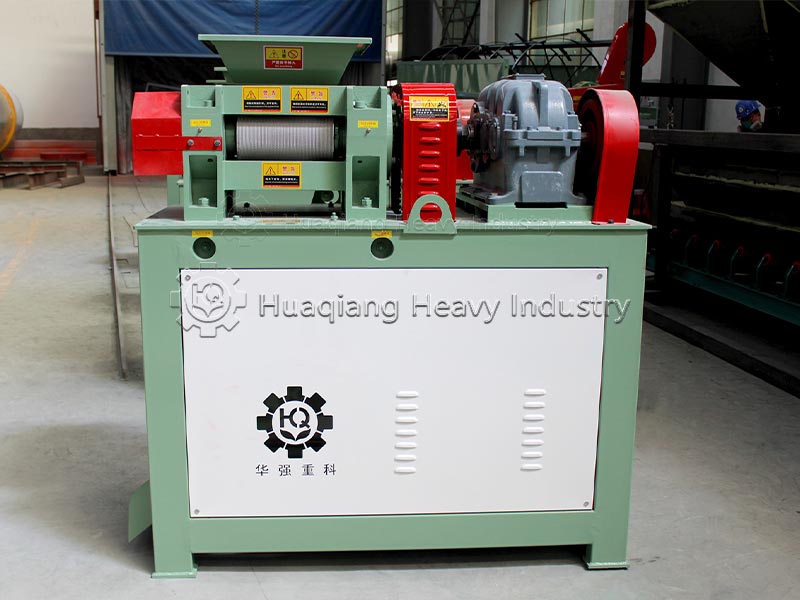
Granules produced via compaction possess a dense internal structure, with a crushing strength of 10–20 N per granule; breakage rates during packaging and transport can be kept below 5%, and nutrient release in the soil is more gradual. The process operates entirely at ambient temperature, making it particularly suitable for heat-sensitive materials. The recycle ratio can be controlled between 30% and 50%, achieving a finished product yield of 70%–80%.
Of course, compaction granulation has its specific scope of application; it is best suited for raw materials with a moisture content below 5%–10% and a fine powder consistency. For small-to-medium-scale NPK projects where raw material moisture can be controlled, the dry-process route centered on compaction offers a viable path characterized by lower investment, reduced energy consumption, and differentiated product quality.