
Wet disc granulation vs. Dry compaction: Two granulation routes for NPK production lines
In an NPK fertilizer production line, the choice of granulation process directly impacts the line’s configuration and operating costs. Disc granulation technology and fertilizer compaction machines represent two distinct approaches-wet and dry-and understanding their differences is essential for effective production line planning.
Disc granulation is a wet process in which materials roll within an inclined, rotating disc; water or steam is applied to cause fine powders to adhere and grow layer by layer. This method achieves a granulation rate exceeding 90%, producing round, uniform granules that enjoy high market acceptance. While it is relatively flexible regarding raw material moisture content and fineness, the process requires downstream drying, cooling, and hot-air furnace units for moisture removal. Drying equipment alone accounts for 25%–35% of the total investment, and fuel consumption represents a significant long-term operating cost.
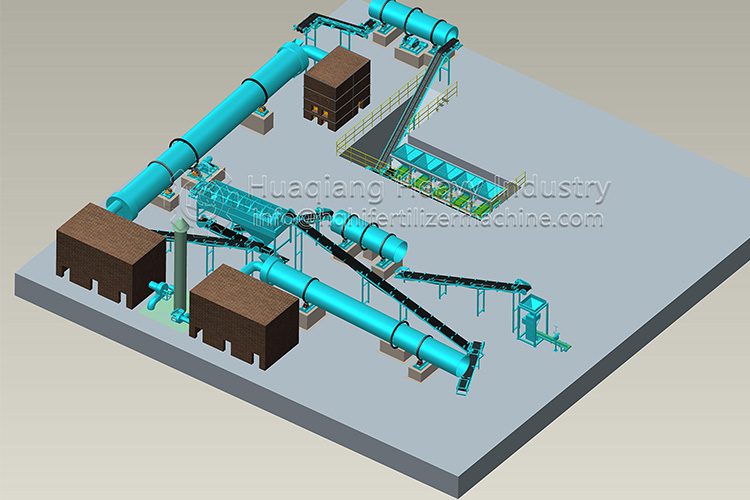
In contrast, fertilizer compaction machines granulate material through purely physical means: powder is fed between two counter-rotating rollers and squeezed under high pressure into dense sheets, which are subsequently crushed and screened into granules. The entire process requires no water, binders, or hot-air drying, eliminating the need for heavy equipment such as dryers and coolers. This results in fewer pieces of equipment, a 30%–40% reduction in required factory floor space, and total energy consumption that is only 30%–50% of that required for wet processes. Compacted granules are dense and possess high compressive strength, resulting in low breakage rates during storage and transport; furthermore, the ambient-temperature operation makes the process suitable for heat-sensitive materials.
When planning an NPK fertilizer production line, disc granulation paired with a drying system is a reliable choice if the market prefers round granules, raw material moisture content is controllable, and the budget is sufficient. Conversely, if minimizing investment scale and operating energy consumption is the priority-and raw materials meet low-moisture requirements-the dry route centered on compaction technology offers a compelling alternative.