
Main types and features of NPK fertilizer granulator machines
The granulator is the core equipment of an NPK compound fertilizer production line, directly determining the particle shape, strength, and nutrient uniformity of the product. Currently, there are four main types, each with different granulation mechanisms and applicable scenarios.
The rotary drum granulator is the most widely used type in large-scale production lines. Materials tumble within an inclined drum, agglomerated into granules by steam or water mist, achieving a pelleting rate of 70% to 85%, with granule compressive strength generally exceeding 12N. A single unit has a capacity of 15 to 20 tons per hour, suitable for large-scale production exceeding 50,000 tons per year, and is particularly adept at processing high-nitrogen formulations.
The disc granulator is known for its simple structure and low investment. Powder agglomerates within an inclined rotating disc with the help of moisture, achieving a pelleting rate of 72% to 85%. A single unit has a capacity of 3 to 15 tons per hour. Its advantage lies in its flexible production changeover, suitable for multi-variety, small-batch production.
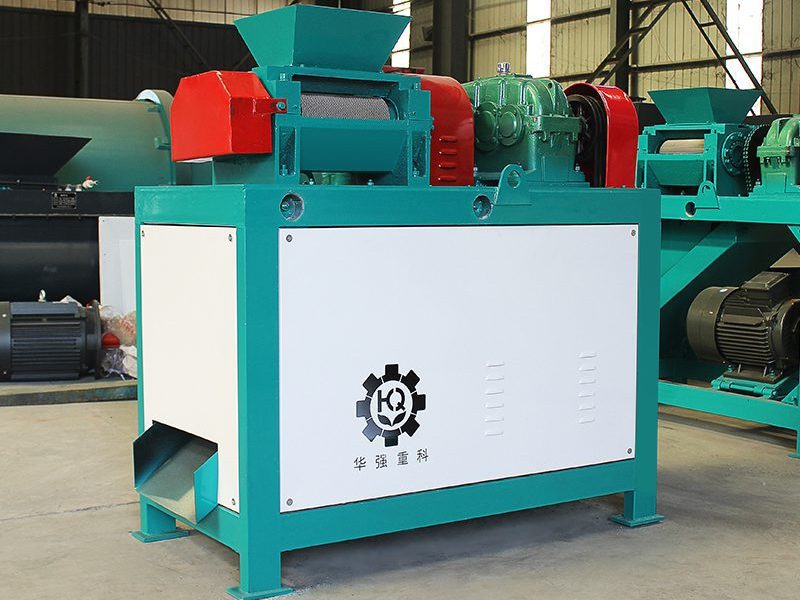
The double roller press granulator employs a dry, high-pressure process, directly pressing materials into shape under pressures of 50 to 200 MPa without the need for water or humidification. Therefore, no additional drying equipment is required, making it suitable for high-concentration formulations.
The high-tower granulation system melts raw materials at high temperatures to create a slurry, which is then sprayed through nozzles at the top of the tower, falling and cooling to solidify. The resulting granules are round and smooth, with high compressive strength and are less prone to caking, making them suitable for high-value-added products, but requiring a larger investment.
Each of the four models has its own applicable boundaries: the rotary drum is suitable for large-scale continuous production, the disc is suitable for small to medium-scale flexible switching, the extrusion is suitable for dry processes and high-concentration formulations, and the high-tower is suitable for high-end product lines. Enterprises should comprehensively select the appropriate model based on their capacity planning, product positioning, and investment budget.