
Core optimization solutions for rotary drum granulators adapted to NPK fertilizer production lines
The rotary drum granulator is a core piece of equipment for the large-scale wet-process production of NPK compound fertilizer. Traditional fertilizer granulators often encounter problems such as uneven particle size, material sticking to the walls, nutrient loss, and equipment corrosion when processing NPK raw materials. By addressing the unique physicochemical properties of NPK fertilizer, multi-dimensional targeted optimizations can effectively improve finished product quality and production line operational stability.
Firstly, internal structure optimization involves adding a standardized guide plate inside the drum, fine-tuning the equipment’s speed and tilt angle, optimizing the material tumbling trajectory, extending material residence time, and improving issues such as uneven particle size and excessive powder, thereby increasing the pelleting rate. Simultaneously, a high-polymer anti-stick liner is added to reduce fine powder accumulation on the walls, minimizing downtime for cleaning.
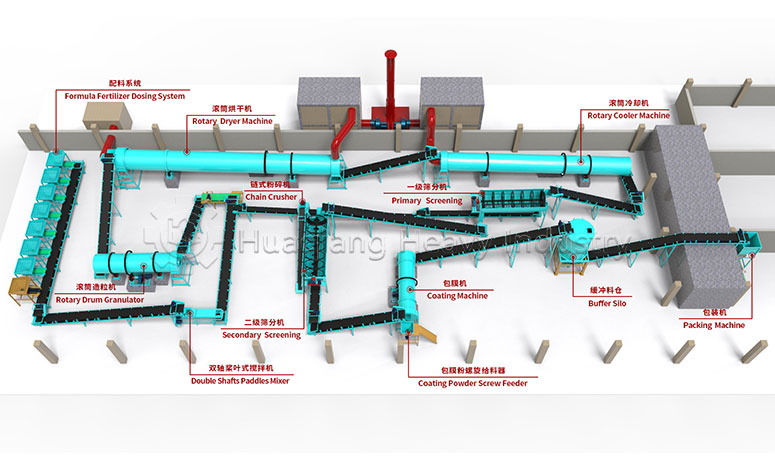
Secondly, the intelligent granulation process is upgraded, equipped with a variable frequency feeding and automatic atomized spray system. Combined with real-time humidity monitoring, the feeding and spray volume are dynamically adjusted to accommodate the hygroscopic nature of NPK raw materials, avoiding material agglomeration and loose particle problems, ensuring uniform and compact finished granules.
Simultaneously, the material and temperature control configurations were optimized, with the material contact parts of the equipment upgraded to stainless steel to resist NPK salt corrosion. A gradient temperature control system precisely controls the production temperature, preventing nitrogen nutrient volatilization due to high temperatures and ensuring fertilizer nutrient levels meet standards.
Finally, the process of mixing new and recycled materials was standardized to aid in stable pellet formation and reduce raw material loss. After comprehensive optimization, the equipment’s pelleting rate and pellet uniformity have significantly improved, and operating costs have been effectively reduced, making it more suitable for large-scale and stable NPK fertilizer production lines.