
Challenges and solutions in chicken manure granulation: Finding the right granulator
Granulating chicken manure is a recognized challenge in organic fertilizer production. Compared to other types of livestock and poultry manure, chicken manure has high moisture content, high viscosity, and uneven fiber distribution, causing significant difficulties for many newcomers to the industry. Selecting the right chicken manure pellet machine requires understanding the logic of matching raw material characteristics with equipment operating principles.
The first major hurdle is moisture content. Fresh chicken manure can have a moisture content of 60%–75%, and even after fermentation, it often remains above 35%. Excessive moisture leads to pellet clumping and inconsistent sizing. To address this, flat die pelleting machines and double roller press granulators allow for dry extrusion without adding water, producing dense pellets and eliminating the need for drying. However, if the moisture content exceeds 25%, extrusion equipment is prone to clogging and slippage; in such cases, the high-speed agitation of a stirring-tooth granulator can rapidly break up wet material into spherical granules.
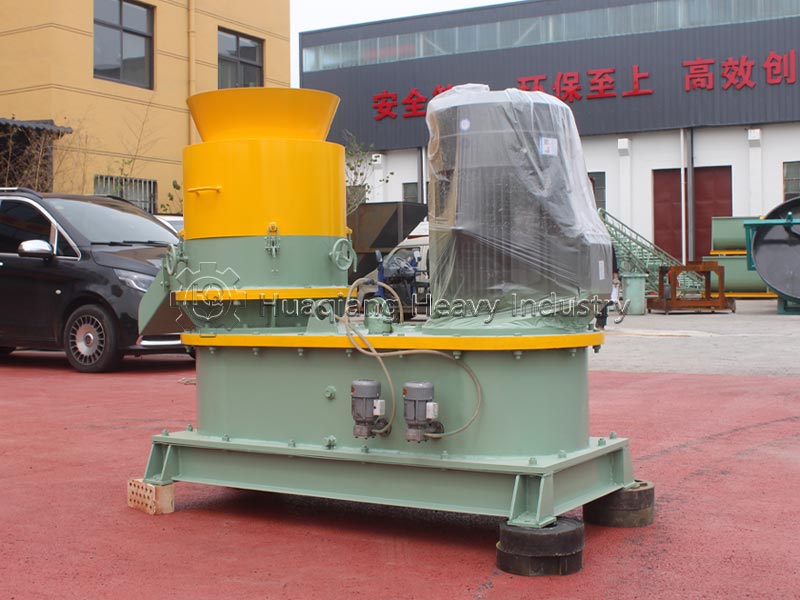
The second challenge is fiber content. Chicken manure contains feed residues and bedding materials (such as rice husks and sawdust) with varying fiber lengths, which can easily wrap around rotating shafts or clog die holes. Stirring-tooth granulators break down fibers through high-speed mechanical shearing, making them the preferred choice for high-fiber raw materials. In contrast, when using a disc granulator, materials must be pre-pulverized; otherwise, the granulation rate drops significantly.
The third challenge is pellet strength. Chicken manure pellets are prone to crumbling during storage and transport. Key factors influencing strength include the degree of raw material decomposition (insufficient fermentation results in loose pellets) and the compaction method. While extrusion and stirring-tooth granulation produce high-strength pellets, disc granulation requires the use of appropriate binders and specific drying parameters.
Selection Strategy: If fermented chicken manure has a moisture content below 20% and has been pulverized, a flat die pelleting machine is the most economical choice. If moisture and fiber content are high, a stirring-tooth granulator is a safer, more reliable option. For large-scale production with an existing drying system, a disc granulator can produce more perfectly spherical pellets. No single machine suits every type of chicken manure, but there is always one that fits your specific raw materials. Testing moisture content, examining fiber characteristics, and determining production capacity before selecting a machine is far more important than blindly asking for price quotes.