
The cost economics of dry granulation: Why more factories are choosing the extrusion route
The choice of fertilizer granulation method directly impacts investment scale and operating costs. Compared to wet drum granulation, the double roller press granulator is becoming the preferred option for an increasing number of factories.
Wet granulation involves multiple stages, including mixing with water, steam heating, hot-air drying, and cooling. The drying process alone requires a hot-blast stove, a rotary dryer, and an induced-draft fan; this entails high equipment procurement costs and imposes a long-term burden regarding fuel consumption. For a NPK fertilizer production line with an annual capacity of 50,000 tons, annual fuel costs for the drying stage alone can reach hundreds of thousands of yuan.
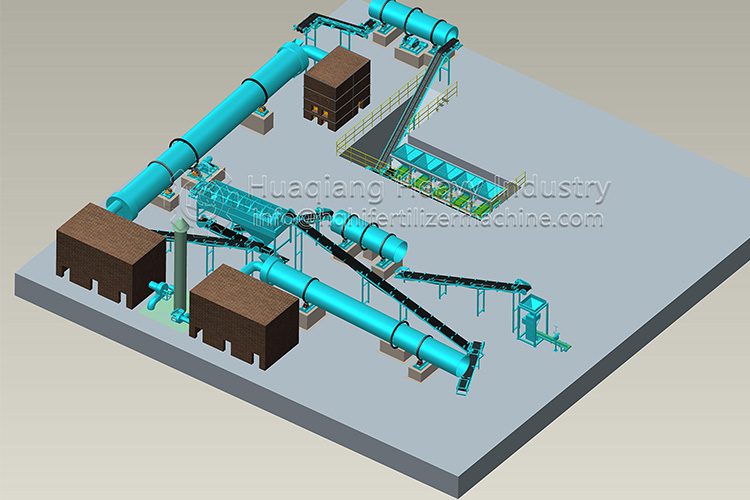
Dry extrusion granulation, however, is completely different. A double roller press granulator uses a forced-feeding system to convey mixed powder between two counter-rotating rollers, compressing it under high pressure into dense sheets; the final product is then obtained through crushing, granulating, and screening. The entire process requires neither liquid binders nor heat sources for drying. The surfaces of the fertilizer compactor’s rollers can be machined with hemispherical pockets or grooves, which directly determine the shape and size of the granules. Operating at ambient temperature makes this type of fertilizer compact machine particularly suitable for heat-sensitive materials.
In terms of equipment investment, dry granulation lines eliminate the need for dryers, coolers, hot-blast stoves, and large dust-removal towers, reducing equipment procurement costs by 30%–40%. Regarding civil engineering, there is no need for large-span factory buildings, and the required floor area is reduced by nearly half. With the elimination of fuel consumption, overall energy consumption drops by more than 50%.
Overall, for mid-to-high-end compound fertilizer projects where raw material moisture content can be controlled, the dry extrusion route—centered on the double roller press granulator—offers significant reductions in both investment and operating costs.